
Safe city no more? Break-ins, dacoities rattle Guwahati; police dispute spike
As Guwahati grows, such crimes raise questions on apartment safety, policing gaps & fragile community vigilance across city
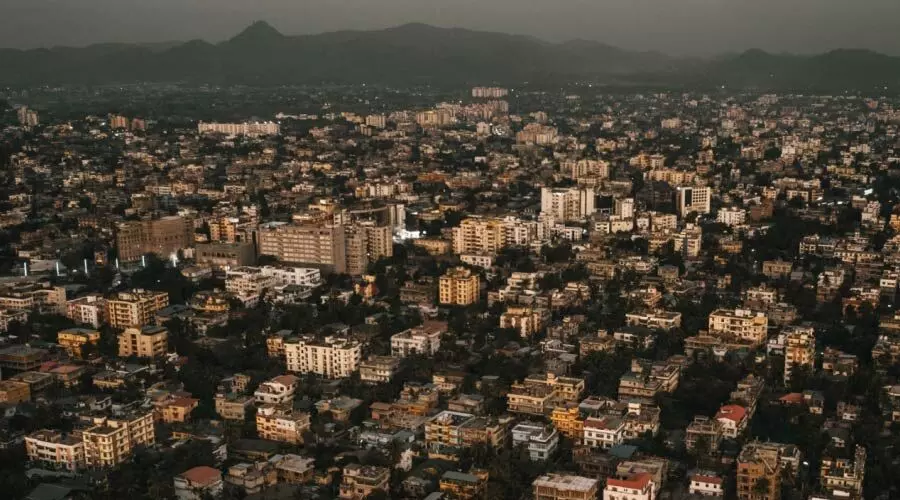
Aerial view of Guwahati. (Photo: Unsplash)
A string of recent robberies and dacoity cases has cast a fresh shadow over Guwahati’s sense of safety. The unease sharpened last week after Guwahati police shot an accused robber in the leg during an early morning encounter at Ten Mile along G.S. Road in Amerigog, after he allegedly attempted to flee from custody.
That crime dates back to January 30, when three robbers, including the accused, allegedly broke into two flats at Nirupama Apartment on Chilaray Path in Beltola. Investigators later linked the case to a wider pattern of organised residential break-ins.
A week earlier, on January 22, police arrested two persons in connection with another dacoity reported from Ganeshpara under the Fatashil Ambari Police Station area.
Taken together, these cases point to a worrying trend. In just one month, Guwahati has seen multiple incidents of dacoity, armed robbery and break-ins, many of them targeting apartment complexes once considered relatively secure.
For residents, the impact goes beyond crime statistics. “The incident is horrifying, especially for someone like me who lives alone with my mother. People no longer seem afraid of brandishing weapons or even killing,” said Himakshi Das, a Jalukbari resident.
Parijat Sarma of Last Gate echoed the sentiment, saying the steady stream of crime reports has reshaped everyday behaviour.
“Even if it hasn’t happened in our locality, it makes you constantly alert,” she said, adding that the sense of safety traditionally associated with gated living has begun to erode.
As the city grows and its skyline fills with new housing clusters, these incidents have triggered uncomfortable questions.
Police dispute spike in crime
While reports suggest a surge in such crimes in the city, police officials maintain that the numbers tell a different story. DCP (Central) Shambhavi Mishra said crime data does not support claims of a rise in dacoity cases in the city.
“There hasn’t been any statistical rise in the city. In fact, it has reduced a lot. In overall theft cases, dacoity constitutes only about four to five cases,” Mishra told The Assam Tribune.
The officer also sought to address widespread confusion over crime terminology, often used interchangeably in public discourse.
“Dacoity is when five or more people are involved and force is used. Robbery involves fewer than five people, again with force. Theft is when someone enters a house and steals something without the victim’s knowledge,” she explained.
According to Mishra, the recent incident in Ganeshpara qualifies as dacoity, while the Beltola case was a burglary. Yet, for residents, such distinctions offer little comfort.
While police data suggests dacoity remains limited in number, residents argue that fear generated by violent crimes cannot be measured through statistics alone. "That fear doesn’t disappear just because the numbers are low,” said Das.
Who is being targeted?
Explaining why Guwahati often becomes a focal point for such crimes, Mishra pointed to changing urban demographics and lifestyles. “Most of the people involved come from outside; they are not locals. Guwahati has many affluent families, which makes it attractive for criminals,” she said.
She also highlighted how evolving family structures have increased vulnerability. “Senior citizens often stay alone as their children live abroad or in other states. In many households, the male member stays outside for work while women stay alone at home,” Mishra added.
Mishra further noted that urban anonymity often works in favour of offenders. Unlike closely knit neighbourhoods, city localities rarely function as watchful communities.
“In villages, if something happens, people immediately come together. In cities, even neighbours hesitate to step out or ask what happened,” she said, underscoring how the absence of collective vigilance makes crimes easier to execute and harder to deter.
A CCTV image of Ganeshpara dacoity case
Fear outpaces crime statistics
Some residents feel this reality is particularly worrying for apartment dwellers, where a sense of shared responsibility is often missing.
“During the COVID lockdown, two flats in our apartment were robbed when families were away. That incident shook everyone. After that, our central committee installed CCTV cameras across the complex,” she recalled.
Despite these measures, she pointed to recurring gaps in on-ground security. “We have two gates with night guards, but residents often complain that the guard at the back gate is absent or asleep. The committee responds to complaints, but the issue keeps repeating,” Das said.
Parijat described a similar situation in her apartment complex, where security arrangements remain minimal. “We do have CCTV coverage, but there is no night security guard. At night, the area becomes very quiet, and that itself feels unsafe,” she said.
Not just apartments
As anxiety grows around apartment living, both police and residents caution against narrowing the focus to gated complexes alone. Officials say urban crime cuts across housing types, with independent houses, rented accommodations and mixed-use neighbourhoods facing similar risks.
“I don’t think apartments are being specifically targeted. There have been burglary attempts in independent houses too,” Parijat said.
Mishra echoed this view, noting that urban crimes are influenced more by opportunity than location. On how residents can assist the police, Mishra stressed the importance of vigilance and verification.
“Proper verification of visitors, tenants are a must. If residents notice anything unusual, they should immediately inform the police,” she said.
She added that the police have also begun strengthening neighbourhood-level coordination.
“We collect the contact details of security in-charges and apartment presidents or secretaries, hold common meetings with them, apprise them of the situation and share police contact numbers,” Mishra said.
Policing & preventive measures
Even as residents flag gaps in local security, police officials say multiple preventive measures are being put in place to deter crime and improve response time across the city.
Addressing concerns, Mishra said the police have stepped up preventive policing across Guwahati. “Patrolling has been increased. We are actively keeping records of people staying in hotels, Airbnbs and homestays,” she said.
Emergency response systems have also been strengthened. “If there is a distress call, we respond very fast through the 112 ERSS (Emergency Response Support System System). A new Integrated Command and Control Centre is also being set up at Khanapara,” Mishra added.
The police have also introduced a senior citizen registration module on the Sewa Setu portal to better identify and assist elderly residents living alone, a group increasingly seen as vulnerable.
As Guwahati continues to expand and urban living becomes increasingly isolated, the challenge lies not just in crime control, but in rebuilding community vigilance.