
Guwahati’s killer landslides: A crisis born of neglect, encroachment & unplanned growth
Protecting the city’s fragile ecology demands strict adherence to construction norms, political will, and collective citizen action
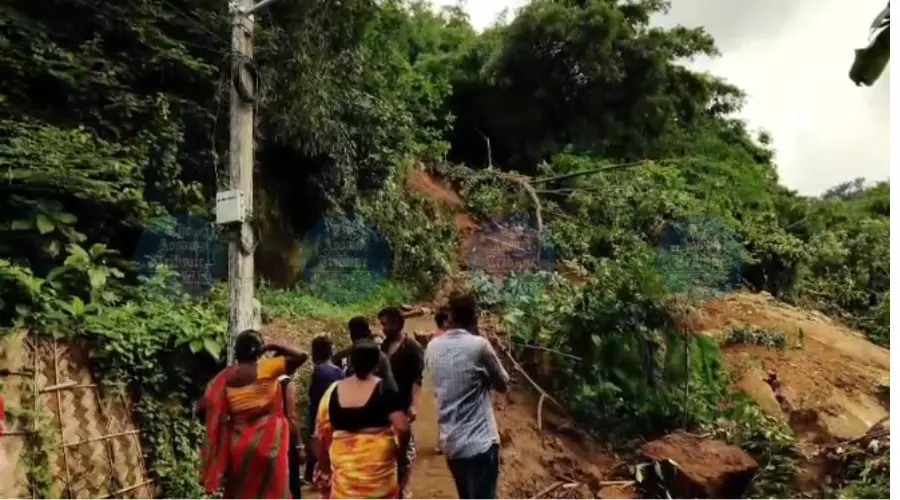
Locals gather at the site of the landslide in Rupnagar (AT Image)
Yet another life was lost to killer landslides on Monday, with the unfortunate victim's house getting buried under debris of mud and rock. Indeed, landslides in and around the hills of Guwahati have remained a familiar phenomenon for the past two decades.
But even more disturbingly familiar has been the inertia of the government authorities in tackling the situation with appropriate interventions.
This lack of response, in fact, has been a part of a larger malaise that has our civic authorities and the district administration in its vice-like grip. Even as Guwahati continues to grow and expand rapidly, little has been done to ensure that the growth is scientific and in sync with all norms of modern urban planning.
The rainy season, which is a nightmare for the citizens because of frequent waterlogging, also witnesses the worst of landslides. These two recurring phenomena are but fallouts of the city's unscientific growth and faulty planning. The city's hills have been subjected to all sorts of human vandalism in the form of encroachment, deforestation and earth-cutting, severely affecting their fragile soil structure and overall ecology.
This has ensured that the vandalism on the hills gets perpetuated. Similar is the case with the wetlands-a majority of them have been converted to human settlements without sparing any thought for the ill-effects that such an unwise alteration of the natural environment would invariably bring.
The onus of effecting a change for the better lies square-ly on the administration and the government authorities.
Protection of whatever still remains of the city's once-pristine environment must be accorded top priority. The sanctity of the hills, forests and water-bodies has to be recognised and maintained accordingly.
With settlements expanding on the hills, it needs to be ensured that norms of construction on such terrains are assiduously adhered to. Assam is surrounded by several hilly States where large populations reside on the hills but we hardly get to hear any news of landslide-triggered fatalities there.
This is because every norm concerning construction is followed in its letter and spirit and the hills are not vandalised for short-term human benefit. Our ongoing haphazard development process has to be checked so that it becomes compatible with the needs of the environment.
Bureaucratic efficiency apart, firm political will is the need of the hour to accomplish all this. The sad reality, however, is that it is the political class that often encourages encroachment on hills, forests and wetlands to further their narrow, short-term political gains.
Given the circumstances, the citizens, too, have no less an important role to play in saving the city.
Collective action by the people can become a potent tool to trigger the desired transformation. If adequate public pressure is there, we can even compel our unresponsive authorities into action.