
BSF’s first drone squadron: A strategic leap in border security amid rising threats
The BSF deploying its first drone squadron marks a significant shift toward high-tech defence, integrating surveillance and attack UAVs to counter evolving threats.
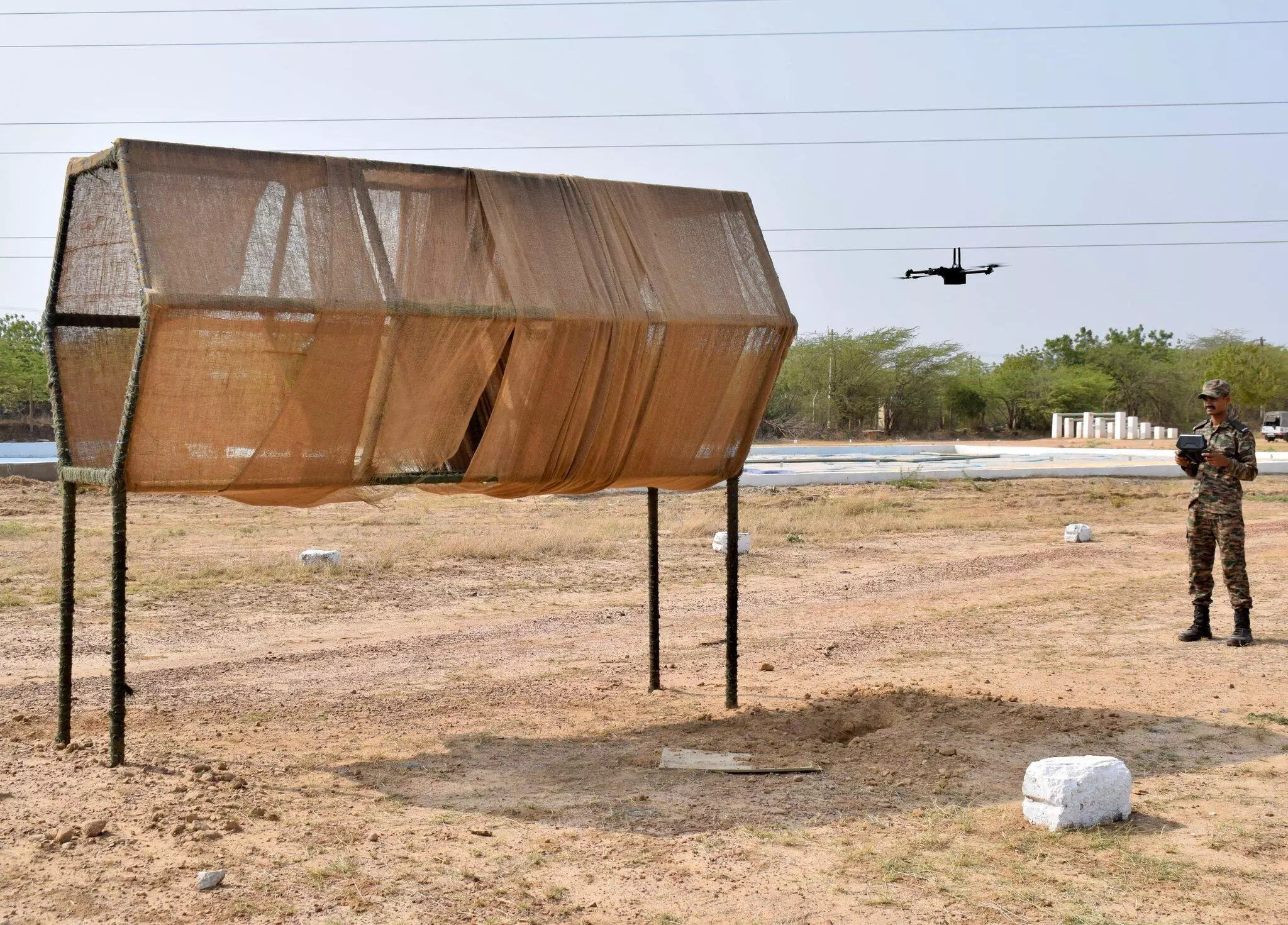
An Indian Army soldier handling a drone (Photo: @KonarkCorps / X)
The rising incidence of aerial threats from Pakistan has prompted the Border Security Force (BSF) to raise its first drone squadron to counter the hazard. One may recall that the neighbouring country took recourse to large-scale lethal drone attacks during Operation Sindoor. The need for a more robust and technologically advanced defence strategy was never more urgent as it is today. Now, the BSF drone unit will be deployed at select border outposts along the India-Pakistan frontier and will include reconnaissance, surveillance and attack drones operated by specially-trained personnel.
The new drone squadron to be manned by trained personnel will be stationed at BoPs spanning the over 2,000-km Indo-Pak border across Jammu, Punjab, Rajasthan and Gujarat. Installing counter-drone technology at key locations will help intercept and neutralise rogue UAVs. Today's warfare being highly sophisticated, it warrants specialised attack and counterattack options.
Indeed, it's a bit perplexing why we did not have a drone unit across the highly strategic and volatile Indo-Pak border all these years. India's emerging security challenges on its frontiers with Pakistan and China have understandably witnessed changes and it is highly imperative that India develop an adequately restructured response mechanism.
It is good to see the deployment of the drone squad, which is a direct response to recent security challenges, particularly Pakistan's use of drone swarms targeting Indian military and civilian areas during Operation Sindoor.
Drones apart, India's international border with Pakistan needs further augmentation from diverse perspectives, including fortification of border infrastructure. Indeed, a multi-pronged mechanism comprising enhanced intelligence, upgraded physical infrastructure and technological integration is a must to counter the evolving nature of the threats.
During Operation Sindoor, Pakistan responded by sending thousands of drones across the border and one such deadly attack claimed two BSF personnel and an Army jawan, besides critically injuring four others. The BSF has since begun adding some protective measures, including reinforcement of bunker walls and roofs with alloy sheets and other additional shielding defence mechanisms.
While the Indo-Pak border definitely warrants a lot of sustained focus from the government, the Indo-Bangladesh border, too, should be brought under enhanced surveillance to prevent illegal migration from Bangladesh and also to keep a tab on the entry of radical Islamic outfit members.
Assam has been at the receiving end of large-scale infiltration from Bangladesh over the decades and although the phenomenon has eased considerably in recent years, there can be no lowering of guard. The spectre of cross-border hazards in the form of illegal migration, smuggling, and sneaking of radical elements into Assam continues to loom over Assam and only a round-the-clock foolproof vigilance mechanism can thwart these dangers.