
Tripura battles rising child marriages, Sepahijala district tops with 103 cases in 3 months
Tripura's Sepahijala district has recorded 103 child marriages between April and June 2025, the highest in the state.
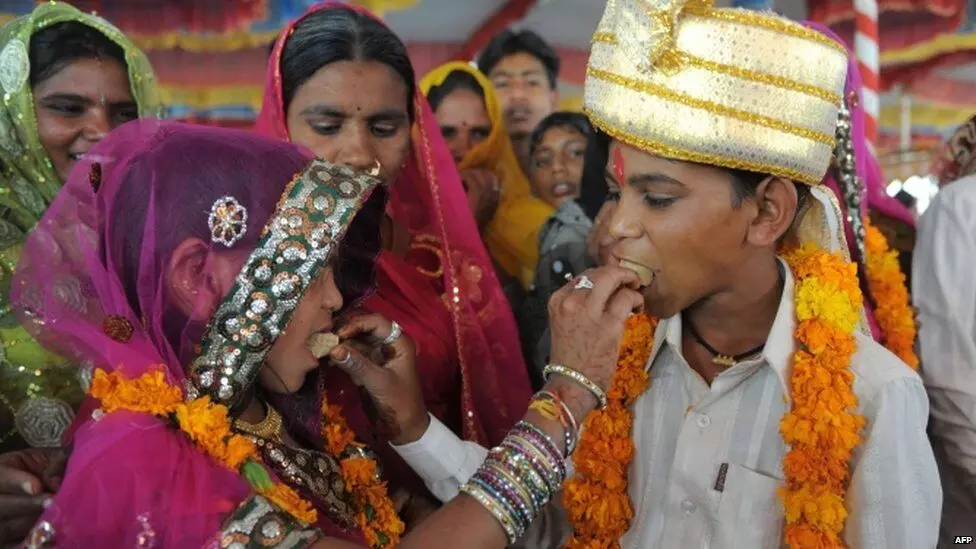
A stolen childhood and a life being altered before it begins (Photo - @WIrvineauthor / X)
Agartala, August 5: Tripura continues to grapple with the persistent social issue of child marriage, with Sepahijala district emerging as the worst-affected region in the state. Between April and June this year alone, the district recorded 103 confirmed cases of child marriage, officials said on Tuesday.
The troubling figures come even as the district administration successfully foiled 101 additional attempted child marriages during the same period under the state’s flagship ‘Mission Sankalp’ programme, a multi-pronged initiative designed to combat child marriage, teenage pregnancy, and substance abuse among youth.
South Tripura followed with 43 cases, while Dhalai, an aspirational district, reported 33 incidents and prevented 31 planned marriages involving minors.
According to the National Family Health Survey (NFHS), Tripura ranks third nationally in terms of reported child marriage cases, highlighting the severity of the issue in this northeastern state.
Calling child marriage one of Tripura’s most urgent social challenges, Tapan Kumar Das, Director of the Social Welfare and Social Education Department, said the problem is deeply rooted in economic backwardness and social inequality.
“Poverty, illiteracy, lack of social support, and now even the influence of social media are driving child marriages in rural areas. Girls are still viewed as a burden by many families, and the pressure to marry them off early remains strong,” Das said.
To counter these trends, the department has rolled out community-driven interventions in collaboration with district administrations. Among them is ‘Balika Manch’, a school-based committee comprised of both teachers and students. The committee tracks attendance, and if a girl student is absent for several days, her peers are encouraged to report it. This often leads to early intervention and, if necessary, panchayat involvement.
Funding from the ‘Beti Bachao, Beti Padhao’ scheme has also enabled awareness campaigns at the district level to educate communities about the long-term harm caused by child marriage.
Sepahijala District Magistrate Siddharth Shiv Jaiswal, who is leading efforts in the worst-affected district, shared that ten border villages in Sepahijala have received the “Aspirational Child Marriage-Free” certification, after reporting no incidents in the past six months.
“Recognition and incentivisation are central to our strategy. Sepahijala is now emerging as a model district for its strong community engagement and proactive governance,” Jaiswal said.
Officials are also confronting the increasing role of social media in underage elopements.
“Many adolescents meet online, form relationships, and elope without understanding the consequences,” said Tiffani Kalai, Deputy Director of the Social Welfare Department. “In many such cases, we are unable to trace them, which presents a major challenge.”
While the data shows that efforts like Mission Sankalp are beginning to yield results, the sheer number of reported and attempted child marriages underscores how much work remains.
Tripura’s government and civil society now face the urgent task of breaking the cycle of poverty, patriarchy, and digital vulnerability.
- PTI