
Nagaland govt opposes Centre’s Article 370-like provision for FNT
Instead, state backs Article 371A-based model for FNT, similar to Assam’s Article 371B councils
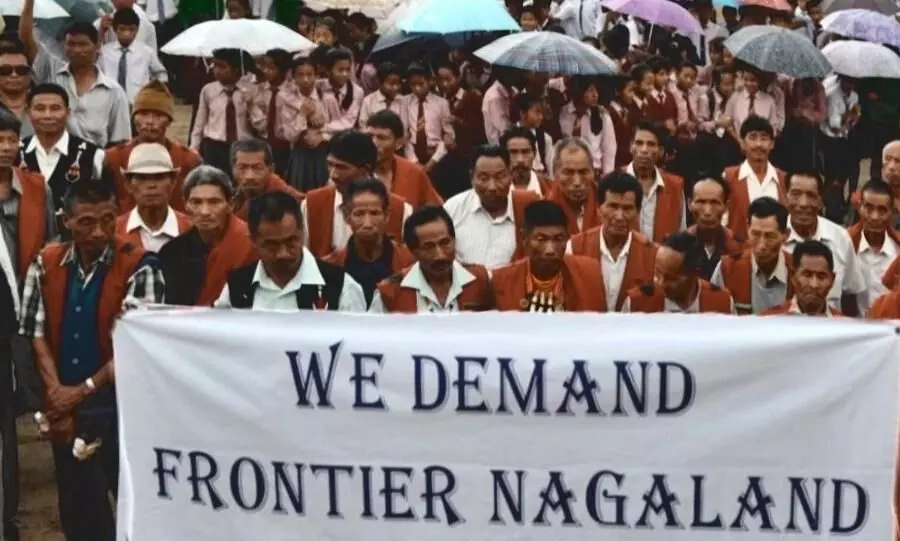
A file image of ENPO members staging a demonstration demanding Frontier Nagaland Territory. (Photo:X)
Kohima, Aug 7: The Nagaland government has strongly opposed the Centre's proposal to grant a separate constitutional provision — potentially under Article 370 — for the proposed Frontier Nagaland Territorial Authority (FNTA), calling it a move that would "amount to territorial bifurcation of the state".
Addressing a press conference in Kohima following the state cabinet meeting on Wednesday, Minister for Power and Parliamentary Affairs and Government Spokesperson K G Kenye said that while the state supports the demand for administrative, financial, and judicial autonomy for the Eastern region, it is firmly against the creation of any separate political identity that severs its constitutional and territorial link with Nagaland.
"The state government is not opposed to autonomy as per the original demand of the Eastern Nagaland People's Organisation (ENPO), but we will not support any arrangement that detaches the region through a separate constitutional article," Kenye stated.
He said the Centre's proposal to place the FNTA under a new constitutional article, akin to Article 370, has raised serious concerns.
Instead, the state government proposes an arrangement under Article 371A, similar to the autonomous councils in Assam under Article 371B, he said, adding that the state cabinet also flagged suggestions such as granting voting rights to ex officio members in regional councils as unconstitutional.
A Nagaland Cabinet delegation is scheduled to visit New Delhi after Independence Day to present the state's stand before the Union Home Ministry, Kenye said.
The state government has also decided to review its 48-year-old job reservation policy in response to increasing pressure from both backward and non-backward tribes in the state.
While five major tribes have demanded a revision, other backward tribes are calling for its continuation.
Citing official data, Kenye said, "Five non-backward tribes currently occupy 64% of government jobs, whereas ten backward tribes hold only 34%."
However, to address this imbalance, the government will constitute a Reservation Review Commission, led by a retired senior government official.
The Commission will include one official each from the Personnel and Administrative Reforms Department and Law and Justice Department, the Home Commissioner, along with a representative each from the Central Nagaland Tribes Council (CNTC), ENPO, and Tenyimi Union.
The Commission is tasked to submit its report within six months from the day it would be formally appointed, but the implementation of the reforms may coincide with the caste-based census scheduled by the Centre in January 2026, the minister said.
PTI