
White collar terrorism growing faster than we realise, says former IB special director
Former IB director NK Mishra warns that educated professionals joining terror groups pose a greater threat.
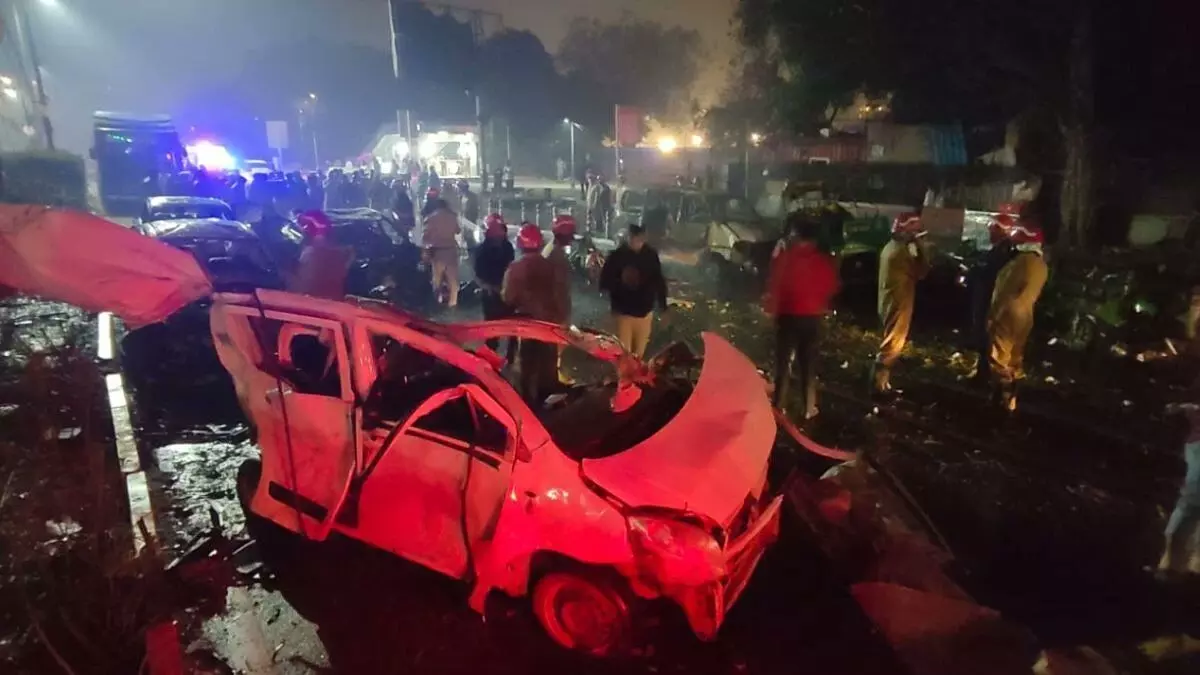
A still from the explosion site near Delhi's Red Fort on November 10. (Photo:@iambenten___/X)
Guwahati, Nov 13: White collar terrorism is more dangerous than conventional terrorism. The explosives recovered from the doc-tors could have caused many more blasts than the recent Delhi blast. NK Mishra, the former Special Director of the Intelligence Bureau, made this observation.
that on March 10, security forces arrested eight persons, including doctors and recovered nearly 3,000 kg of explosives from them. On the same evening, Delhi witnessed a major blast, where the involvement of a doctor is suspected.
When contacted by The Assam Tribune, Mishra, who was also a former DGP of Sikkim, pointed out that white collared terrorists are much more dangerous because they would have a wider influence among the misguided youths. Such people have better knowledge and networking than others.
Mishra pointed out that educated people like doctors are joining terrorist groups primarily because of radicalisation. "Earlier, we had seen educated people getting into terrorism. But in recent times, we are witnessing more and more educated people getting into terrorism, and radicalisation is the major factor behind this dangerous tendency. Misguided religious ideology is the driving force behind such incidents," he added.
Replying to a question as to why doctors, who take an oath to save the lives of people, are getting involved in killings, Mishra said that religious fanaticism is the prime cause behind that.
Replying to a question about how many explosions could have been caused by the explosives recovered from the arrested doctors, Mishra said that many more such explosions could have been triggered off. He pointed out that the number of explosions would have depended on the nature of the target.
"We should also look for unrecovered explosives, if any, which may be a cause of concern," he added.
On the steps needed to be taken to deal with the problem, Mishra said that the first step would be to enhance the capability of the police and security forces. India's own mechanism has been improved with better coordination between the police and security agencies. But there is always scope for improvement, and that is a continuous process. When no terror attack takes place for a long time, we tend to become a little lax. The security forces should never lower their guard, he said.
Mishra further said that efforts should be made to address the issue of radicalisation. A close watch has to be maintained on the nexus between Indian citizens and terror groups sitting across the border.
If any incident of terror takes place, efforts should be made to neutralise the impact. Post-attack management and confidence-building are key aspects.