
India’s first DNA census shows elephant numbers drop 18% to 22,446 nationwide
Officials caution that new jumbo population figures are not directly comparable due to changed methodology & sampling
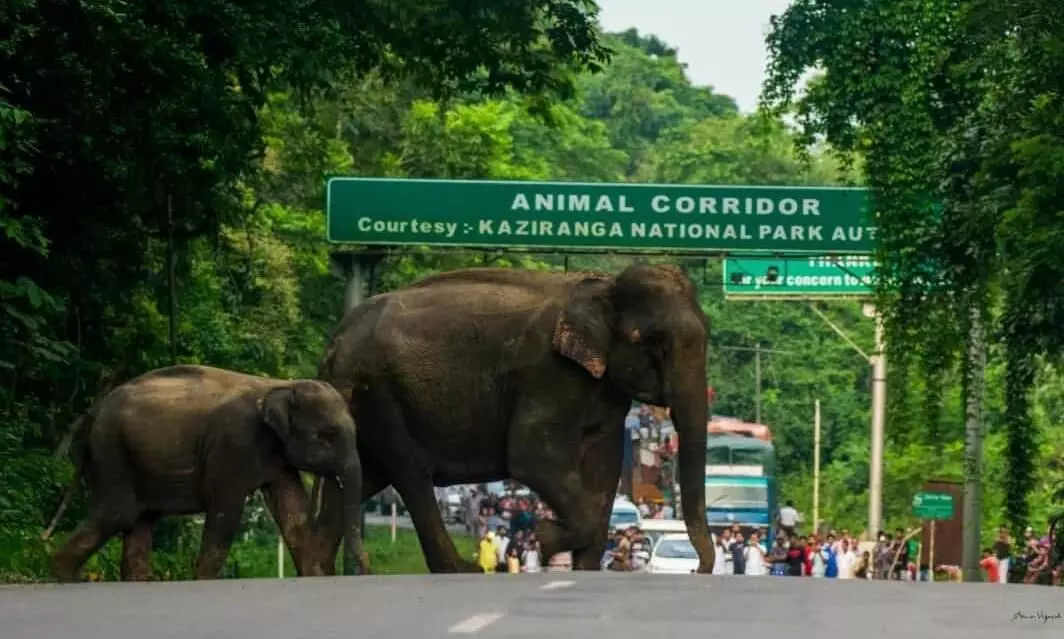
A file image of elephants crossing the road near Kaziranga. (Photo:X)
New Delhi, Oct 16: India’s wild elephant population has seen a worrying decline over the past decade, with the latest census estimating the number of elephants in the country at 22,446; nearly 18% lower than the 2017 count of 27,312.
The findings are part of the All-India Synchronous Elephant Estimation (SAIEE) 2025, the country’s first-ever DNA-based census of wild elephants, released earlier this week.
The report places the elephant population between 18,255 and 26,645, with the average pegged at 22,446.
The exercise, launched in 2021, was delayed by nearly four years due to complex genetic analysis and data validation.
Officials have cautioned that the new figures are not directly comparable with earlier estimates because of a change in methodology and sampling techniques.
Reacting to the findings, former Environment Minister Jairam Ramesh said that despite the technical caveats, the data points to a significant drop in elephant numbers; a development he described as deeply concerning.
“Even so, there is a very high probability that the elephant population has declined over the past decade. The new census estimates between 18,255 and 26,645,” Ramesh wrote on social media.
The Congress leader attributed the decline to changing land use patterns, habitat loss, and increasing human-animal conflict, along with pressures from mining and infrastructure projects that have fragmented traditional elephant corridors.
“The elephant faces a crisis; perhaps not of extinction, but of attrition,” Ramesh said, stressing that protection of the species is a “national duty”.
Ramesh also criticised the amendments to the Wildlife (Protection) Act, 1972, passed three years ago, claiming they have not strengthened conservation outcomes.
India had declared the elephant its national heritage animal on October 22, 2010, during Ramesh’s tenure as Environment Minister, in recognition of its cultural and ecological importance.
“‘Haathi’ is indeed our ‘Saathi’,” he recalled, reiterating the need for sustained efforts to preserve the species and its habitats.
While the Environment Ministry has not formally responded to Ramesh’s remarks, officials said the DNA-based methodology adopted for the latest census would help improve accuracy in future population monitoring and enable better conservation planning.
PTI