
Inside Assam’s mushroom boom: From simple crop to high-value products
From fresh & dried mushroom to pickles, biscuits & even chocolates, farmers have unlocked a world of possibilities from a single crop
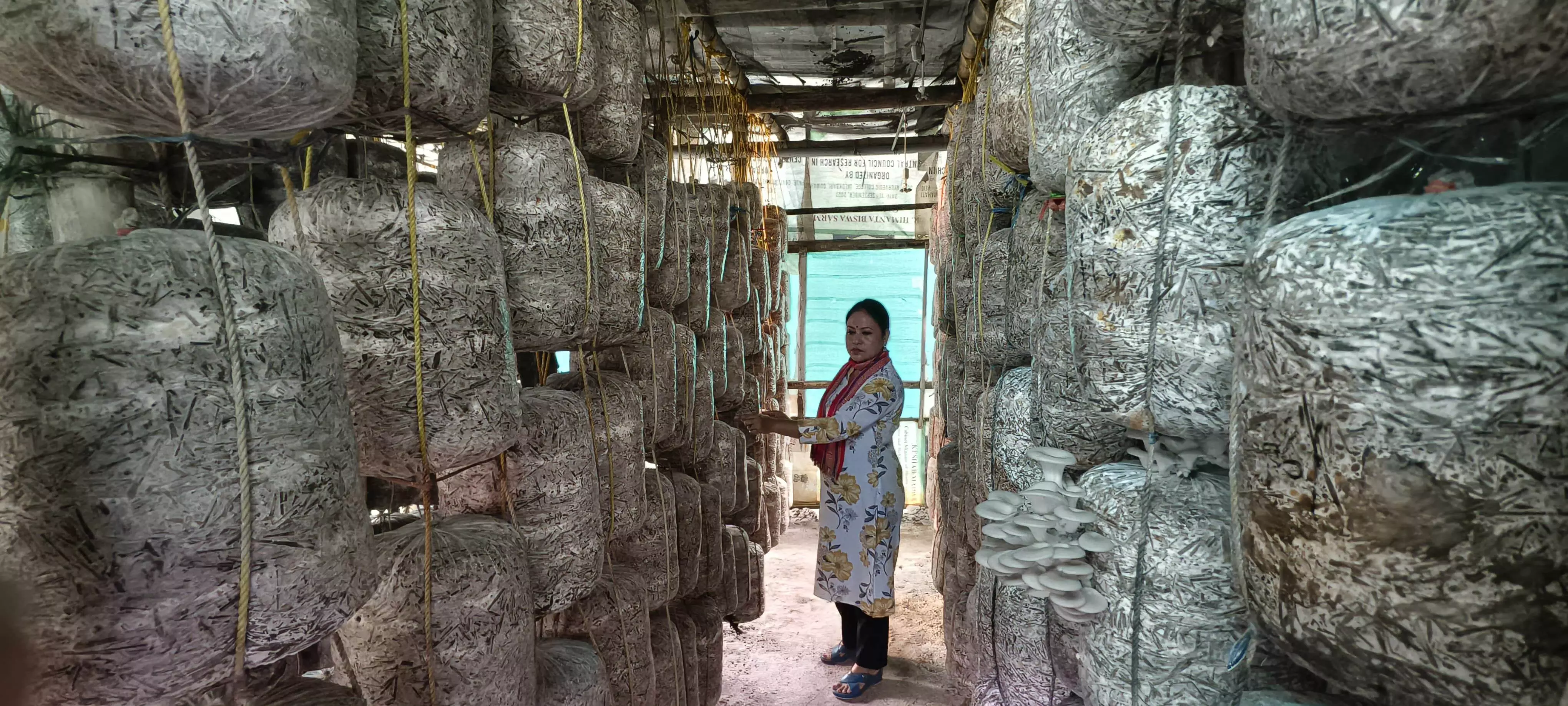
Kanaklata Das with her crop. (AT Photo)
Guwahati, Nov 18: A wave of local entrepreneurship is reshaping Assam’s push for self-reliance, with mushroom cultivation emerging from a small-scale activity into a thriving, innovation-driven ecosystem.
With growing demand for fresh produce and mushroom-based products, more people are turning to this low-cost, high-return venture to secure their livelihoods.
In Guwahati’s Lalmati, one farm has shown how value addition can transform livelihoods.
From fresh and dried mushroom to pickles, biscuits, powders and even chocolates, the enterprise has unlocked a world of possibilities from a single crop, drawing in customers from across the region.
For founders Kanaklata Das and Anuj Kumar Saikia, the journey began a decade ago with a simple mission. The mission was to promote mushroom cultivation across the Northeast.
“We started by focusing on raw and dried mushrooms, but slowly explored how many products can be created from them. Today we make raw mushroom, dried mushroom, mushroom powder, biscuits, and six varieties of pickles,” says Kanaklata.
Mushroom cultivation in Guwahati (AT photo)
She elaborates on their expanding range. “We prepare bhut jolokia mushroom pickle, chilli mushroom pickle, pineapple mushroom pickle, tamarind mushroom pickle, coconut mushroom pickle, and garlic mushroom pickle. We’ve also developed mushroom protein powder, chocolates, and noodles. These are ready, and we plan to launch them in the market soon", Das said.
Their work extends far beyond production. Since 2016, the duo has travelled across Assam, Manipur, Mizoram, Nagaland, and Meghalaya, training villagers and especially women in mushroom cultivation.
They also helped farmers sell their produce, creating a chain of shared benefit and community growth.
The COVID-19 pandemic temporarily halted all activities, but the founders restarted their farm from scratch soon after.
“We rented land in Guwahati and rebuilt everything step by step. Today the farm employs around 12 people, and we hope to grow that number to 200 as we expand to 4–5 bighas,” says Kanaklata.
The response to their mushroom-based products has been remarkable.
“We take part in various exhibitions, both in Assam and other states. Our products have reached Nagaland, Manipur, Dimapur, and exhibitions in Gujarat, Delhi, and Meghalaya,” she says.
They also operate an outlet at Bhetapara, and their participation in Advantage Assam drew appreciation from international visitors.
“Guests from abroad really enjoyed the mushroom-based food items we showcased,” she recalls.
One of the biggest strengths of mushroom cultivation is its affordability.
“With an investment of just Rs 5,000 to Rs 10,000, anyone can start mushroom cultivation,” says co-owner Anuj Kumar Saikia.
He adds that nearly a thousand women trained by them are now earning Rs 15,000 to Rs 20,000 per month, turning mushroom farming into a reliable income source.
Over the past decade, they have trained about 10,000 people across the Northeast.
Currently, they are active in districts near Guwahati such as Nalbari, Barpeta, Nagaon, Morigaon, and Goalpara, training new farmers and supplying high-quality mushroom seeds sourced from West Bengal, Siliguri, and Cooch Behar.
Explaining the basics, Anuj says, “All you need are rice husk, polythene, bamboo, and high-quality mushroom seeds. With these, anyone can begin cultivation at home or on a small plot.”
Mushrooms are now gaining recognition for their nutritional value.
“They are rich in protein and beneficial for people with diabetes, cancer, high blood pressure, and even constipation. As health-conscious consumers turn to natural and nutrient-rich foods, the demand for mushroom-based products is expected to rise further,” Anuj concludes.