
Reclaiming the statesman Gopinath Bordoloi, who stood between Assam & Partition
Cabinet Minister Jayanta Mallabaruah reflects on how Assam has restored Lokapriya Gopinath Bordoloi to the heart of its political and cultural consciousness
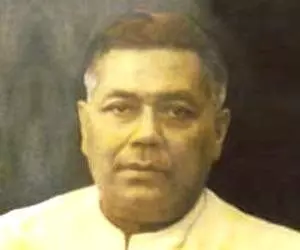
As Assam prepares to witness a historic moment on December 20, when Prime Minister Narendra Modi inaugurates the new integrated terminal of Lokapriya Gopinath Bordoloi International Airport, the occasion goes far beyond infrastructure.
The Prime Minister’s visit, marked by the unveiling of an 18-foot statue of Bharat Ratna awardee Lokapriya Gopinath Bordoloi within the airport premises, is a powerful statement: It signals that Assam’s history, identity, and sacrifices are no longer peripheral to national consciousness; instead, they are central to it.
For decades, the Congress, ironically, Bordoloi’s own party, has reduced him to a nameplate. An airport name abbreviation. A ceremonial reference once a year. His ideas were buried, his courage sidelined, and his legacy deliberately muted.
His erasure was not accidental. It was political convenience.
Gopinath Bordoloi stood like a rock when Assam’s future was under threat during Partition. He fought the Muslim League’s agenda to merge Assam with East Pakistan.
When the Cabinet Mission Plan endangered Assam’s sovereignty, Bordoloi did not surrender to Delhi’s political calculations. He revolted from within the Congress itself.
Backed by Mahatma Gandhi and Sardar Patel, Bordoloi resisted Jawaharlal Nehru’s willingness to sacrifice Assam for so-called “larger political stability.” Nehru himself feared that supporting Assam would “let loose chaos and civil war.”
He sent Bijoy Bhagwati and Mahendra Mohan Choudhury to meet Mahatma Gandhi at Srirampur. He fought tooth and nail to protect Assam’s identity. Jinnah could hope to get the moon but could never hope to put Assam in Pakistan under Bordoloi’s watch.
Bordoloi was also a pioneer of tribal rights and indigenous autonomy.
He worked closely with Dr BR Ambedkar to ensure constitutional safeguards for tribal communities – principles that later shaped the Sixth Schedule. He believed in coexistence without surrender and autonomy without appeasement.
Bordoloi countered a nefarious plan
Assam’s immigrant population from then East Bengal had been leveraged as an argument in favour of giving away the Assam region to East Pakistan (now Bangladesh) during Partition. And if it wasn’t for Gopinath Bordoloi, the map of India would have looked quite different.
Bordoloi emerged as the strongest political counter to both the Muslim League and its Assam leader Md Sadulla, at a time when the very future of the State was at stake.
After the 1936 provincial elections under the Government of India Act, 1935, Bordoloi led the Congress as Leader of the Opposition while Sadulla formed the government with external support.
During Sadulla’s tenure, policies encouraging the large-scale settlement of migrant Muslims and neglect of indigenous concerns triggered widespread resentment.
When Sadulla’s Cabinet collapsed in 1938, the Governor invited Bordoloi to form the government, recognising his political acumen, integrity, and mass appeal across communities. As Chief Minister, Bordoloi decisively moved to protect indigenous land rights by halting land tax burdens and resisting land allotment to migrant settlers, directly challenging the Muslim League’s demographic strategy in Assam.
Even after resigning during World War II in response to Gandhi’s call and enduring imprisonment, Bordoloi returned to politics with renewed resolve. He consistently opposed Sadulla’s return to power in the 1940s, condemning communal governance and negotiating corrective measures on migrant rehabilitation.
Bordoloi as CM (post-Independence)
Lokapriya Bordoloi’s tenure as Chief Minister stands as one of the most consequential phases in Assam’s modern history. In the immediate aftermath of Independence, Bordoloi worked in close coordination with Sardar Vallabhbhai Patel to safeguard Assam’s territorial integrity against external pressures from both China and Pakistan, ensuring that the State remained firmly within the Indian Union.
At a time of immense upheaval, he played a decisive role in the rehabilitation of millions of Hindu refugees fleeing violence and persecution in East Pakistan, laying the foundations for communal harmony, democratic stability and long-term security in the region. His vision extended beyond political consolidation to institution-building under his leadership, landmark institutions such as Gauhati University, the High Court, Assam Medical College and Assam Veterinary College were established, shaping Assam’s educational and administrative backbone for generations.
He was a follower of Gandhian principles. Yet, why did Congress forget him?
Bordoloi’s legacy exposes the moral collapse of today’s Congress. Modern Congress politics thrives on selective memory, appeasement, and vote-bank dependency. Bordoloi’s uncompromising stand against communal politics, illegal migration, and demographic manipulation does not align with Congress’s strategy.
As indigenous communities – Bodos, Karbis, Dimasas, Rabhas, and others – moved away from the Congress, the party doubled down on minority-centric politics. In that framework, Bordoloi became inconvenient.
Bordoloi’s fight to keep Assam from becoming East Pakistan – today’s Bangladesh – stands as a rebuke to the Congress’s silence on demographic aggression and border infiltration. That is why the Congress has buried him in footnotes.
It took a decisive BJP government and the visionary leadership of Prime Minister Narendra Modi, with Chief Minister Dr Himanta Biswa Sarma leading the State, to restore Bordoloi to the centre of Assam’s political and cultural consciousness.
Bordoloi in present times
Gopinath Bordoloi’s core beliefs – protecting indigenous rights, resisting illegal infiltration, countering anti-India mindsets, and building a strong Assam through infrastructure – have become guiding principles for the Assam government under the leadership of Chief Minister Dr Himanta Biswa Sarma.
Today, Bordoloi’s vision is reflected in firm actions against illegal influx through repeated border pushbacks, focused measures to safeguard indigenous communities, and policies that empower locals.
These, along with several other steps, underline the present government’s clear commitment to preserving Assam’s identity and securing the rights and future of its indigenous people.
On Bordoloi’s death anniversary, observed as Lok Kalyan Divas, the Assam government honours public servants through the Lok Sewa and Karma Shree Awards – linking today’s governance to Bordoloi’s ideals. This is not symbolism. This is ideological continuity.
The Prime Minister’s inauguration of the new Guwahati airport terminal and the installation of Bordoloi’s statue together send a clear message: infrastructure and identity go hand in hand. Development without memory is hollow. Growth without roots is fragile.
Lokapriya Gopinath Bordoloi is not just history. He is a compass. For the youth of Assam, his life proves that one leader, grounded in conviction, can change the destiny of an entire region.
Bordoloi is the hero Assam deserved then. And he is the hero Assam needs now.
Jayanta Mallabaruah