
Pulse of the polls: Civic issues dominate New Guwahati’s first electoral test
In Part-II of The Assam Tribune's constituency watch across Kamrup (M)'s five seats, New Guwahati residents demand civic fixes over poll promises
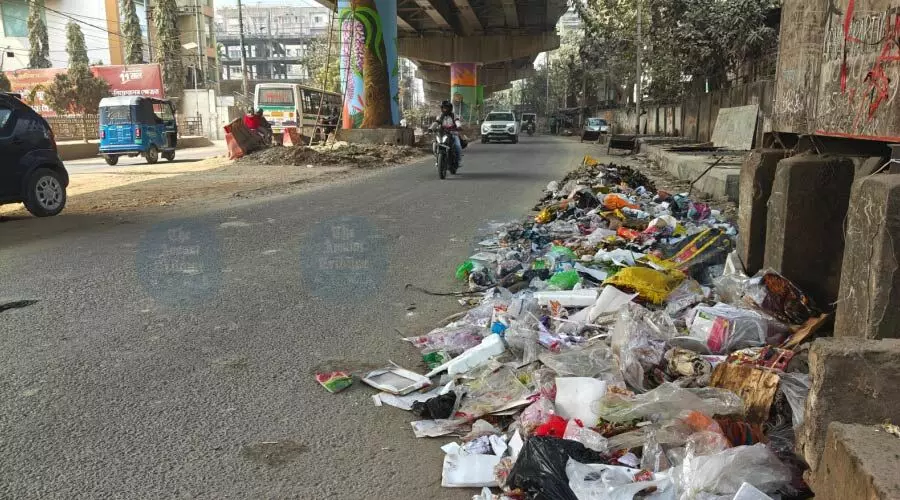
Garbage accumulation and inadequate waste management remain major civic challenges in the newly formed urban seat
Guwahati, Feb 19: Following the delimitation exercise in Assam’s Assembly constituencies, the newly formed New Guwahati Assembly seat in Kamrup (M) is set to witness its first electoral battle, with multiple contenders from major political parties eyeing the prestigious urban constituency.
As election fever grips the state, voter sentiment in the city’s only fully urban constituency indicates a mix of dissatisfaction, cautious optimism and strong expectations from the next legislator.
The New Guwahati constituency has a total of 1,96,016 voters, including 94,390 men, 1,01,621 women and five third-gender voters. Significantly, women voters outnumber men.
The number of polling stations has also increased from 201 to 219. The constituency comprises 17 wards of the Guwahati Municipal Corporation and includes parts of the earlier Dispur and Guwahati constituencies.
With this urban segment emerging as a politically crucial seat, questions remain over candidacy and which party will secure the trust of a largely educated and politically aware electorate.
Against this backdrop and as part of its constituency watch series, "Pulse of the Polls", The Assam Tribune walked through New Guwahati to hear what residents have to say.
Voters spotlight civic gaps
Residents across Zoo Road, Silpukhuri, Noonmati, Bamunimaidan and adjoining areas have flagged artificial flooding, drinking water shortages, poor drainage, deteriorating road conditions and inadequate public transport as their primary concerns.
Poor roads and clogged drains reflect civic challenges in New Guwahati
Senior citizen Dibakar Goswami said that while residents are not grappling with basic survival issues, they are deeply concerned about the quality of urban infrastructure.
“People here do not expect personal favours from politicians. What they want is proper maintenance of the road, improved transport facilities and a permanent solution to artificial flooding. Issues related to drainage and the Bharalu and Bahini rivers must be addressed. Whoever becomes the MLA must prioritise these matters,” he said, adding that many residents were dissatisfied with the limited accessibility of their former representative.
Another resident, requesting anonymity, pointed to a communication gap between elected representatives and the public.
“Public issues in our area have remained unresolved for years. Representatives have not engaged with people consistently. We hope the first MLA of this constituency will stay connected with residents and complete pending projects,” he said.
Several senior citizens also highlighted drinking water as a persistent problem. “The water supply issue has remained unresolved for years. The condition of the Bharalu, Bahini and Mora Bharalu is extremely poor. Despite repeated promises, no tangible work has been done. Taps often run dry,” another resident, who did not wish to be named, said.
Floods, failing roads, mounting waste
For many residents, poor roads, erratic drinking water supply and artificial flooding continue to rank among the constituency’s most pressing concerns. Silpukhuri resident Saras Kumar Bhattacharya flagged a host of unresolved civic issues.
“Development projects often cause inconvenience instead of relief. Contractors have not delivered quality work. Broken water pipelines are leading to wastage, while the GMC has not addressed dust and water supply issues,” he said.
Young voter Junaid Hussain expressed frustration over the lack of visible development. “In the last five years, we have not seen adequate work. Flooding, drinking water shortages, poor roads and garbage management are serious problems. If this continues, people may even consider boycotting the election,” he said.
Students echoed similar concerns. “Artificial flooding makes commuting difficult during the rainy season. We want the next MLA to ensure proper drainage and road connectivity,” said college student Falguni Bhagwati.
Residents from Noonmati pointed to shortcomings in major drinking water projects. “Pipelines have been laid, but there is no water. This reflects poor planning. Even today, people do not get adequate drinking water,” said Pranjal Deka.
Garbage piles and weak waste management remain major concerns
Local resident Madhuranjan Nath added that the JICA water project had not benefited several areas. “There is no proper connection or water supply. The condition of pipelines is poor. People have approached the authorities, but no solution has been provided,” he said.
In Bamunimaidan, Bharat Prasad Barthakur said residents have been forced to purchase water for nearly three years. “We have had to buy drinking water. Road conditions, pollution and drainage issues also persist. The next MLA must address these problems urgently,” he said.
Another resident, Mamoni Goswami, stressed the need for accountability. “Earlier works have not been completed properly, and communication with the public has been lacking. This time, the water issue must be resolved,” she said.
Aspirants pitch development agenda
With multiple aspirants in the fray, unresolved civic issues and a politically aware electorate, the New Guwahati constituency is shaping up to be one of the most closely watched contests in the upcoming Assembly elections.
BJP aspirant Pranab Jyoti Lahkar expressed confidence about the party’s prospects. “This is a new constituency, and I am hopeful of serving as its first MLA. For the past six months, I have been reaching out to people, especially in hilly and interior areas, and providing free health services. I believe the BJP candidate will win, as people want development,” he said.
Waterlogging and neglected roads continue to trouble commuters
Congress aspirant Kushal Kumar Sarma, however, criticised the government’s performance. “The new constituency faces numerous civic issues. While the government claims development, the reality on the ground is different. The fundamental problems of Guwahati have not been resolved,” he said.
Voters, meanwhile, have indicated that development, transparency and accessibility will be key deciding factors in what they describe as the “people’s court” this time.