
Ethics, accuracy & inclusion key to journalism, say panelists at AT Dialogue 25
Media experts including Samrat Choudhury, Afrida Rahman Ali & Ramanuj Dutta Choudhury also highlighted the need for ethics amid fake news & digital disruption
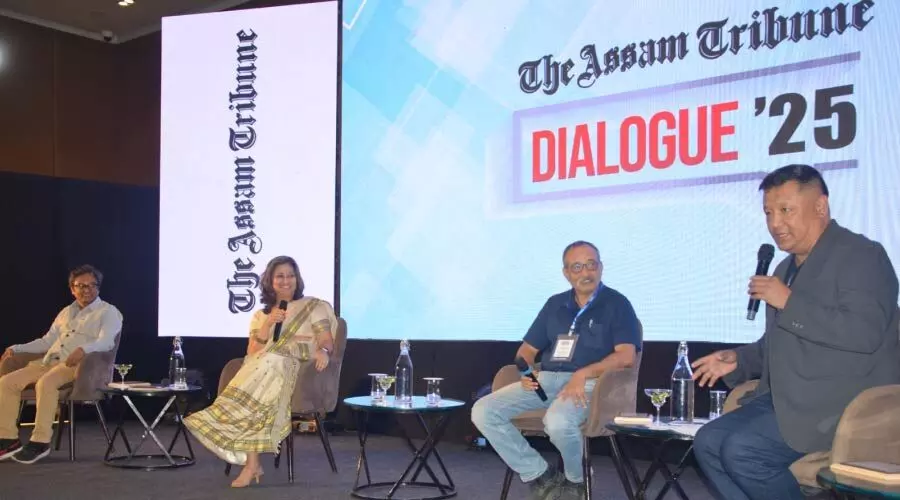
Speakers at the "Ethics in Media: Representing Diversity. Equity and Inclusion" session (AT Image)
Guwahati, Nov 9: Issues of media ethics, diversity, and inclusion came under focus at a panel discussion during The Assam Tribune Dialogue 2025, on Saturday.
Author and journalist Samrat Choudhury, executive editor of Free Press Journal, Afrida Rahman Ali, and Exесutive Editor of The Assam Tribune Ramanuj Dutta Choudhury were present as speakers in the session, moderated by senior journalist and editor-in-chief of East Mojo Karma Paljor.
Turning about the importance of media ethics, Samrat Choudhury said, "Journalism is all about telling the truth. A news should be factual, unless it will become PR or propaganda. It is the duty of every media outlet to remain unbiased, objective and impartial."
Noting that accurate representation of facts is the main duty of journalism, he noted that shouting inside the TV studio is not the actual journalism." He also emphasise on the need to give adequate coverage to places located outside metro cities.
Talking about proliferation of fake news, Choudhury said that in present situation the role of journalist become more crucial in dissemination of actual facts and figures among audience.
“Truth still matters a lot in the society. So, the legacy media needs to re-establish its credibility”, he added.
Afrida Rahman Ali explained how internet has brought changes in journalism in recent times.
“Now, anyone can get any information instantly. So, journalists have to bring the context and back story of every happening. Now, TV audience has also shrink significantly in recent times, as most people choose to watch news in mobile phones," she said.
Ali noted that a journalist must have the courage to push a local story to publish in national and international plat form to highlight pertaining issues.
Talking about narrative building, she stated that although the number of audience has been shrinking, the main-stream media still has lots of resources to control a narrative.
"News is a public service. So, every journalist must maintain sense of responsibility while approving a headline," she added.
Participating in the panel discussion, Ramanuj Datta Choudhury talked about the challenges in media, particularly about fake news.
"In a hurry to break a news, many digital media outlets often publish fake news now. More than 50% of news in digital format are fake. We must ensure authenticity in publishing news”, Dutta Choudhury said.
During the discussion. Karma Paljor observed that media always makes perception in the society and ethical media ecosystem is crucial for the public.
"Now, everyone is opening digital media platforms. Anyone can now produce any content and share it with others. This is the main challenge before us," he said. Paljor, further noted that public must pay if independent media outlets need to keep working in the country.