
Diwali lights glow softer in Guwahati as Zubeen Garg’s absence shadows festive spirit
Markets are quieter, sales sluggish, as the city observes the festival of lights under the lingering cloud of the icon’s loss
A cracker stall in Fancy Bazar
This year, Diwali arrives not with its usual dazzle and joyous clatter but with a sombre hush, born of collective grief over the passing of cultural icon Zubeen Garg.
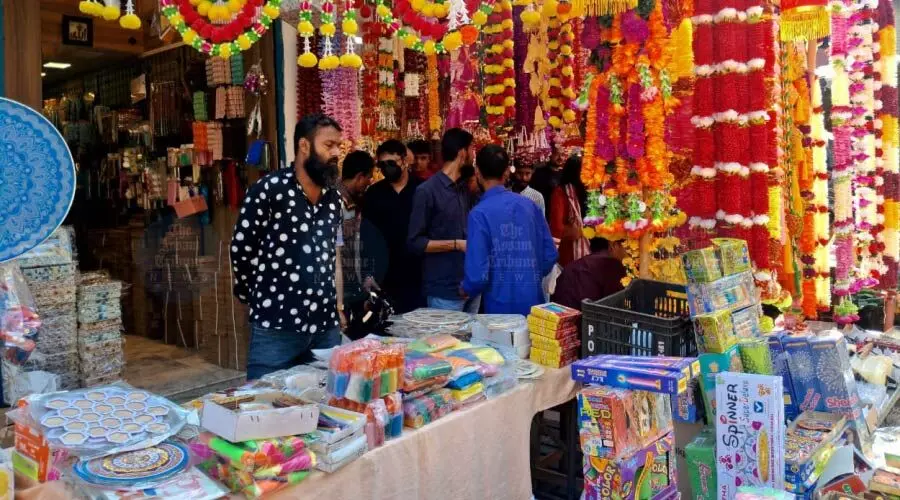
Markets are lined with festival essentials - diyas, fairy lights, green crackers, and rangolis, but sales are noticeably slower than in previous years.
Shopkeepers report a muted festive spirit, overshadowed by the loss of Assam’s beloved singer. Even as homes prepare to light lamps, the joy of Diwali feels tempered by remembrance and mourning.
“Business isn’t what it was last year,” sighs Qutub Ali, who runs a lighting stall in Fancy Bazar.
“During last Diwali, customers kept coming from morning till night. But it’s been three days now, and we haven’t even made Rs 5,000 in profit. We are grieving the singer’s death, but life doesn’t stop—we still have to feed our families," he adds.
Inside a tiny shop stacked with colourful diyas and LED lights, Rupali Das quietly adjusted boxes that would normally sell out in a day.
“Last year, I had to restock every two days,” she says, adding, “Now I still have old stock lying around. It’s strange—people come, look, but don’t buy much. Everyone’s talking about Zubeen. It feels like the city has lost its rhythm.”
A diya stall in Fancy Bazar
Muted festive spirit
In Assam, Diwali has always carried a familiar soundtrack—Zubeen Garg’s voice drifting from every shop, home, and street corner. For many, he wasn’t just a singer; he was the echo of every celebration, but this year, that soundtrack has fallen silent.
Across Guwahati’s Fancy Bazar, the city’s festive heart, lights still glitter and stalls brim with colours, but the spirit feels muted.
“Usually, I play Zubeen’s songs outside the shop to attract customers. But how can I play them now? It doesn’t feel right. The mood is heavy,” says Raju Sharma, who runs a gift shop draped in string lights and paper lanterns.
The sentiment runs deep. Sweet shop owner Rekha Agarwal in Noonmati said business is moving, but not with the usual Diwali enthusiasm. “Sales are okay, but not like before. People are buying fewer boxes. Maybe it’s the sadness, maybe the prices, but the excitement is missing,” she says.
Even young shoppers are noticing the shift. College student Mrinmoy Kalita walked through the market, clutching a few modest purchases.
“Last year, we’d stay here for hours—laugh, click photos, buy whatever we liked. This year, it feels different… quieter, almost reflective. People are still celebrating, but there’s a weight in the air,” Kalita says.
The change is not just emotional, it’s visible. The usual burst of bargaining has softened into hushed exchanges. Conversations about discounts have been replaced by quiet recollections of Zubeen’s songs and memories.
Stallholders say families are shopping with purpose rather than joy; buying what is necessary, not what is festive.
“Even the children are different. Usually, the colours excite them—they’d pull their parents to the stall. But this time, parents are telling them about Zubeen… how he was part of every festival. It’s touching, but also very sad,” observes Rafique Ahmed Khan, a seller of rangoli powders and decorative thalis.
Decorative items stall in Fancy Bazar
Guwahati glows, but quietly
Guwahati will sparkle this Diwali, but this year, the glow will feel softer, the celebrations gentler. The city is celebrating, but with restraint; as though every light lit carries a memory.
“Zubeen’s gone, and it feels like Guwahati itself has dimmed a bit. Diwali is about light, but this year, it’s more about remembrance,” says Khan, arranging a box of Rangoli colours at his stall.
For many, this muted celebration is not just a choice, but a tribute. Homes across the city will light diyas not just for the festival, but in memory of the singer whose voice was once inseparable from every ritual, every celebration.
“We don’t feel like celebrating Diwali this year. Zubeen’s loss feels personal. We will just light diyas and pray for justice for him,” says Rekha Rani Baishya, a resident of Noonmati.
A day ahead of the festival of lights, Guwahati stands delicately poised between celebration and sorrow.
The lights may shine across Guwahati, but its heartbeat feels gentler, slower this year. For many, each diya lit is not just a celebration of light over darkness—it’s a soft homage to a voice that once filled every Assamese home.
As gift shop owner Raju Sharma reflects, “Maybe this Diwali is quieter, but it’s also more meaningful. It reminds us of what really matters—the people we love, the memories we carry, and the voices that shaped our lives. Zubeen will always be part of our Diwali.”