
Govt okays 52 Biplab Sharma panel recommendations; CAA still unresolved: AASU
AASU also presented a position paper & sub-committee report detailing 22 critical concerns of Assam’s indigenous people
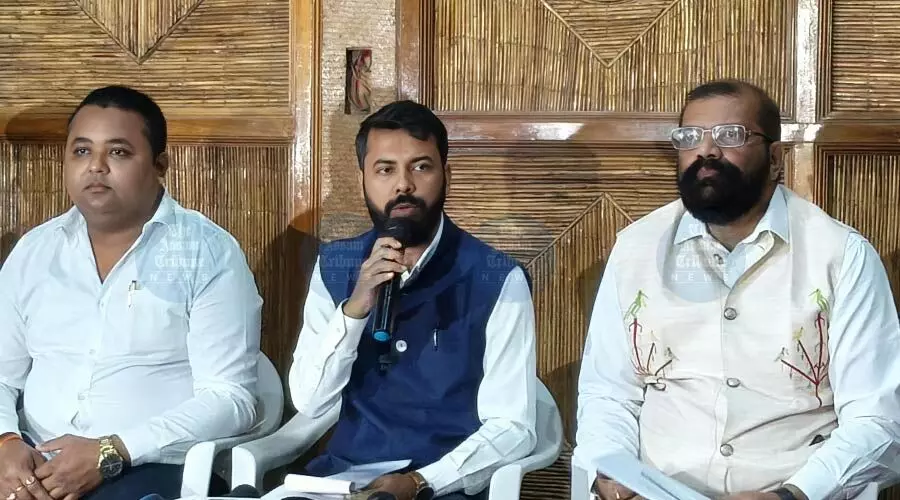
An image of AASU leaders during the press brief in Guwahati. (AT Photo)
Guwahati, Nov 24: The leadership of the All Assam Students’ Union (AASU), on Monday, said the Assam Government has accepted 52 recommendations submitted by the Biplab Kumar Sharma Committee during a decisive tripartite meeting held on November 22.
Briefing the press about the meeting on Monday, AASU leaders said the meeting followed extensive submissions by the organisation and marked “one of the most comprehensive reviews” of Assam Accord–related issues in recent years.
“The Government’s acceptance of 52 recommendations by the Committee marks a significant commitment. The Chief Minister assured that the approved points would move to Cabinet consideration and be implemented in phases, several of which are already reflected in the 2024–25 Budget,” AASU said in a statement.
The students’ body said this round of discussions was crucial because it enabled a detailed examination of long-pending matters related to land rights, cultural preservation, administrative reforms, and the rights of indigenous communities.
AASU also submitted a detailed written position paper, along with a separate sub-committee report highlighting 22 critical issues concerning the indigenous people of Assam.
However, the meeting failed to reach an agreement on the contentious Citizenship Amendment Act (CAA), which AASU continues to staunchly oppose.
“The government and we could not be on the same page regarding the CAA issue. But apart from that, the sub-committee’s recommendations have been agreed upon. AASU has urged the government to ensure time-bound completion of all accepted issues,” the statement added.
Earlier in September, Chief Minister Himanta Biswa Sarma had stated that after four years of deliberation, the government had decided to implement 52 of the 67 recommendations made by the Biplab Kumar Sharma Committee.
The Chief Minister had also acknowledged that Assam’s diversity posed certain challenges in executing the recommendations.
The Biplab Kumar Sharma Committee submitted 67 recommendations related to the implementation of the Assam Accord - 40 under the State government, 15 under the Centre, and 12 requiring joint action by both.
Land protection, illegal encroachment & surveys prioritised
A major portion of the Government’s accepted recommendations centres on land protection, with authorities committing to a strict crackdown on illegal encroachment under the Assam Land Policy and the Assam Land and Revenue Regulation, 1886.
A state-wide land survey will be completed by 14 April, after which all land settlement will be carried out only through verified procedures.
The Government also agreed in principle to enact a new law to protect land belonging to indigenous communities, restrict the sale of land to non-Indians, and issue a special notification safeguarding prime agricultural land from non-agricultural conversion.
Digitisation under the Unique Land Parcel Identification Number (ULPIN) system will also be introduced.
Language, culture & education reforms approved
The Government has committed to a wide set of language and cultural reforms, including:
- Assamese to be compulsory in all English-medium schools in the Brahmaputra Valley.
- In the Bodoland Territorial Region (BTR), both Bodo and Assamese will be compulsory subjects.
- From the 2026 academic year, Assam History and Geography will be mandatory up to Class VIII.
- Formation of a Committee on the Ahom Language Script.
- Initiatives to preserve the Assamese language among the diaspora.
- Establishment of Chairs for Assamese Language and Culture at Tezpur University and possibly Gauhati University.
- Construction of Sahitya-Sanskriti Bhawans in 12 districts with an allocation of Rs 480 crore.
Additionally, the Government will create district-wise heritage complexes for indigenous communities, a State Centre for Languages, and dedicated cultural complexes to preserve tribal and ethnic traditions.
Major Initiatives for Satras, heritage sites & creative institutions
AASU welcomed the State’s commitment to strengthening heritage and religious institutions:
- Rs 50 crore for the development of Madhupur Satra.
- A special heritage scheme for Batadrava Than, birthplace of Srimanta Sankardev.
- Rs 100 crore for an international-standard museum in Nagaon dedicated to the saint.
- Expansion of facilities at Jyoti Chitraban, with AASU-involved committees advising on project planning.
- Budgetary provisions confirmed for recruitment to the Jyoti Chitraban Film Studio Corporation.
- Construction of multipurpose cultural centres named after Sahityarathi Lakshminath Bezbaroa in every district headquarters.
- An initial allocation of Rs 240 crore for centres in 12 districts.
- A special allocation of Rs 100 crore to the Srimanta Sankaradeva Kalakshetra, including Rs 50 crore in the 2025–26 State Budget. Consultations on utilisation will be held with AASU.
Environment, forest protection & indigenous livelihoods
The Government announced Rs 47.86 crore for strengthening forest and wildlife protection over the next five years, alongside new battalions of the Assam Forest Protection Force. AASU urged the Government to fill the large number of vacant posts in the Forest Department.
The meeting also discussed rehabilitation of families displaced by the 2001 Bhogdoi river erosion, sustainable value-addition of Assam’s natural resources, and socio-economic support for indigenous groups affected by migration, erosion, border insecurity and land loss.
AASU Sub-Committee Flags 22 Urgent Issues
AASU’s Sub-Committee report highlighted critical concerns, including:
- Illegal migration and demographic impact
- Land loss and encroachment
- Threats to language and culture
- Border issues with Bangladesh
- Livelihood losses in riverine and forest-fringe areas
- Socio-economic backwardness
- Lapses in protective frameworks for indigenous communities
- AASU demanded publication of the “K-File Report” on illegal foreigners, release of the 1971 migration records, and swift identification of post-1971 entrants.
Monitoring Committee to Oversee Implementation
To prevent delays, the Government will constitute a Monitoring Committee comprising AASU representatives, government officials and subject experts. The committee will monitor progress, ensure compliance across departments, and follow up with the Central Government on pending matters.
The Chief Minister assured that all unresolved issues would be reviewed and that AASU would be kept informed of further developments, the AASU’s leadership said.