
From 47% in 1951 to record high in 2026: Assam’s voter turnout journey
But since the mid-1980s, the turnout has been above 70 percent. It crossed the 80 percent mark in 2016 and has remained there since then.
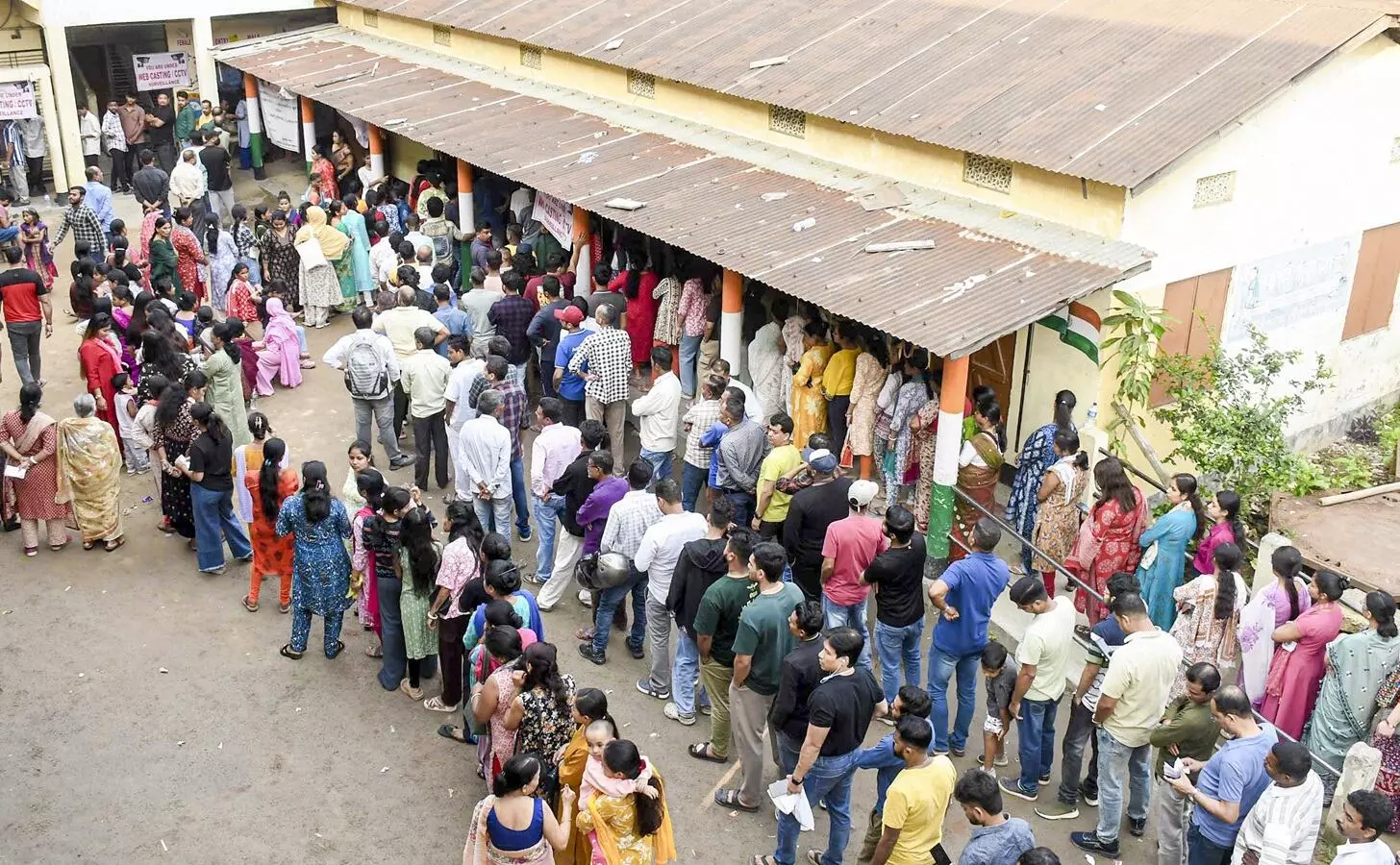
People wait in queues before casting their votes at a polling station in Guwahati. (Photo:PTI)
GUWAHATI, April 12: With the State recording its highest ever turnout in the April 9 Assembly polls and stakeholders citing competing reasons behind the numbers and about its likely outcome once the EVMs are unsealed on May 4, it is worth noting that the rate of participation of the electorate of Assam in the democratic exercise has generally been impressive in recent decades.
Besides, a glance at the data shows that there is no hard and fast rule regarding turnout numbers and election results.
From the first Assembly elections held in 1951, the polling percentage kept fluctuating over the next three-and-half-decades, albeit with an overall northward trajectory.
But since the mid-1980s, the turnout has been above 70 percent. It crossed the 80 percent mark in 2016 and has remained there since then.
The voter turnout was 47.54 per cent in 1951.
It went up to 51.37 percent in the 1957 Assembly elections, before going down marginally in 1962 to 51.05 percent.
The turnout jumped to 61.83 per cent in the 1967 polls, before once more declining to 60.85 per cent in 1972.
In the post-Emergency polls held in 1978, which saw the Congress party lose power for the first time in Dispur, the polling percentage jumped to 66.86 per cent.
The 1983 Assembly elections, held during the period of the Assam Agitation amidst massive public boycott and violence, witnessed the voter turnout plummet to only 32.74 per cent, the lowest ever. That record still stands.
In 1985, following the signing of the historic Assam Accord, the Assembly polls witnessed the turnout rise to an astonishing 79.21 per cent. The first AGP government came to power in those elections.
Voter participation fell to 74.67 per cent in 1991, when the Congress party wrested back power.
It again went up to 78.92 in 1996 when the AGP won the elections for the second time.
The turnout stood stable at 75.05 per cent in 2001, 75.72 per cent in 2006, and 76.04 per cent in 2011, when the Congress won three consecutive elections.
But in the 2016 Assembly polls, it climbed to 84.67 per cent, as the BJP-led NDA swept to power in Dispur for the first time.
It dipped to 82.42 per cent in 2021, when the NDA retained power.
As per provisional figures, the turnout in the just-concluded polls stands at 85.92 per cent, surpassing all previous records.
As such, Assam’s political history has witnessed elections like those of 1978, 1985, and 2016, when a higher turnout resulted in change of regimes, as also occasions like 1991 and 2001 when a dip in the polling percentage also led to similar outcomes.
While higher polling in other states also used to be associated with anti-incumbency till a few years back, that is no longer true in a general sense.
Bihar reported its highest ever turnout in the Assembly elections held in 2025 that brought back the ruling NDA to power with a thumping majority.
In 2024, Maharashtra registered its highest voter turnout in 30 years. There also, the incumbent government retained power.
In Assam, the Muslim-dominated Legislative Assembly Constituencies (LACs) have traditionally registered a higher rate of polling compared to other seats.
But this time, even the LACs where the indigenous communities reside in larger numbers have bucked the trend of low voter participation. All the seats of Kamrup Metro district shed the tag of urban apathy and reported respectable turnouts.
If polling of over 96 per cent was registered in Birsing Jarua and Jaleswar LACs and over 95 per cent in Dalgaon, Mankachar, and Chenga LACs, the turnout reported from seats like Tihu, Rongonadi, Rangia (over 87 per cent each), and Bongaigaon (over 90 per cent) is no less impressive.
Then there is the angle of the Special Revision (SR) carried out in Assam. The SR led to a decrease of 2.43 lakh names in the final roll published in February this year, shrinking the size of the electorate by nearly one per cent, a factor that must also be taken into account while analysing the 2026 turnout figures.
In addition, the high polling percentage also suggests successful mobilization by the political parties on Election Day.
And then the mild weather on April 9, with light showers at many places across Assam and lack of heat and humidity, must also be taken into account.
Speaking to The Assam Tribune, senior leaders of the major political parties gave their own interpretations about the record turnout and likely impact on election results.
State BJP chief spokesperson Kishore Upadhyay attributed it to greater participation by the electorate belonging to the indigenous communities, people’s satisfaction with the performance of the present government, and their desire to vote for continuity.
On the other hand, Assam Pradesh Congress Committee (APCC) vice president Mehdi Alam Bora said it points to massive anti-incumbency, the electorate’s desire for change, especially among the young voters in the age group of 18-39 years, and growing distaste against ‘divisive politics’.
AIUDF general secretary Haidor Hussain Bora claimed the high polling in the minority belt will help the Badruddin Ajmal-led party.