
Durga, Ishtar & beyond: Tracing global story of goddess worship through ages
From Durga in India to Ishtar in Mesopotamia, goddess worship reflects ancient reverence for feminine strength worldwide.
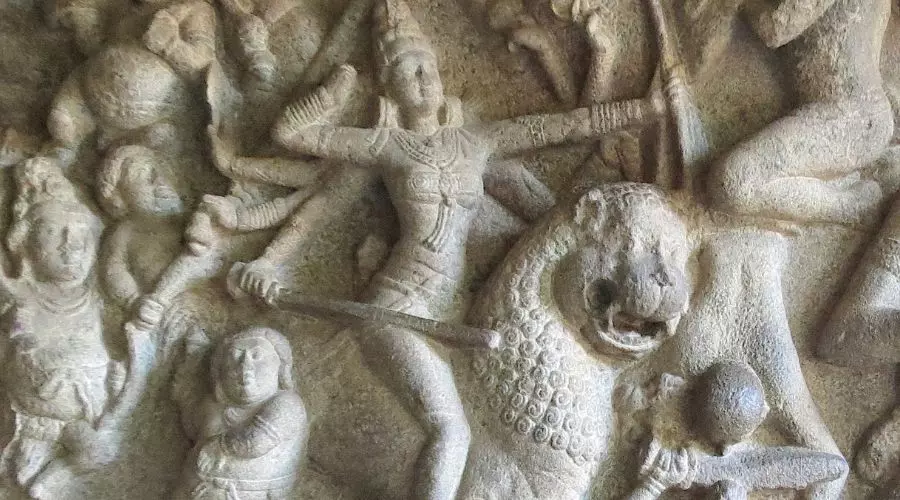
An image of eight handed Durga.
To practise various religious rituals is an age old tradition as old as human civilisation. Since they started living as a society, the concept of God representing supernatural powers controlling things beyond human understanding was conceived and people used to worship such power in different forms representing different entities like fire, water, wealth. Such things are evident from various religious scriptures and statuettes discovered from various parts of the globe.
Here we are discussing the female deities worshipped across borders starting with Durga Puja in India. The sense carried by Durga is difficult to touch. Durga is known as Mahishasurmardini (Demon in buffalo form slayer), Mahamaya, Saradiya Devi (Autumn Goddess), Jagatmata (Mother of world), Bhagawati, Parbati, Parbatja (mountain daughter), Chandi, Annapurna, etc., to represent her in different forms.
The most ancient terracotta statuette has been found in Tonk district of Rajasthan. Durga is mainly revered as the God of war and is imagined in Her ten-handed incarnation, though an eight-handed stone statuette has been found in Mahabalipuram.
The discovery of many little statuettes from the archeological excavation sites of Harappa and Mohenjodaro indicates that the practice of worshipping the Mother Goddess prevailed there. A statuette carrying a lotus on the head named ‘Padma’ has been discovered in Mohenjodaro.
In Vedic era, a form of Goddess as ‘mother of the people’ was worshipped. Since the day the concept of power evolved, the worship of the Goddess commenced. We find the reference of devi worship in the Ramayana where, interestingly, Ravana, the greatest devotee, agreed to perform puja for his own annihilation arranged by Rama.
Durga is worshipped in Nepal in the form of nine different grains. In the Crete island of the Mediterranean Sea, reference to a stick-wielding Goddess perched on a lion is found. The inhabitants there worship this Goddess as the one controlling the crops, the earth, the mountains and the serpents also. Some remnants of female deity worship have been traced in the Great Britain also. In ancient Britain, before Christ, Mother Goddess was worshipped as the Goddess of Nature, fertility, and the Earth. Statue worship was not performed.
Some statues carved out of rocks, bones and made of soil have been found, which may indicate the existence of an ancient ritual of devi worship there.
Ishtar was a major Mesopotamian Goddess, primarily known as the Goddess of love, beauty, fertility, and war, and was also associated with the star of Venus. Worshiped by the Sumerians (where she was called Inanna), Akkadians, Assyrians, and Babylonians, she was a multifaceted deity embodying both stimulating love and destructive war, with a complex and powerful Nature.
She was the Queen of Heaven and Earth and a patroness of major cities like Uruk, with her influence extending to later goddesses like Astarte.
Different female figurines have been discovered in various places of Asia Minor. They are known in different names like Kubaba, Hecate, Ma, Mabolama, etc., in South East Asia a female dragon slayer deity resembling Durga was worshipped. A young deity was worshipped as the deity of water in Iran. Some statuettes of this deity with small waist and high bosom have been discovered.
It transpires that the practice of worshipping of deity prevailed in various part of the world. The practice of performing worship bestows people with religious strength, unity and renewed zeal apart from the feeling of joy and enthusiasm. The study of ancient scripts and archeology takes us into a tour of this ancient practice. The worship of the Goddess since time immemorial represents the respectful and honourable status of woman in ancient societies across the world.
By Rashmirekha Hazarika.