
Encroachment & urbanisation risk Guwahati’s natural treasure, Amchang Wildlife Sanctuary
Spread across 78.64 sq km, Amchang, an elephant corridor now faces severe threats from encroachment & deforestation
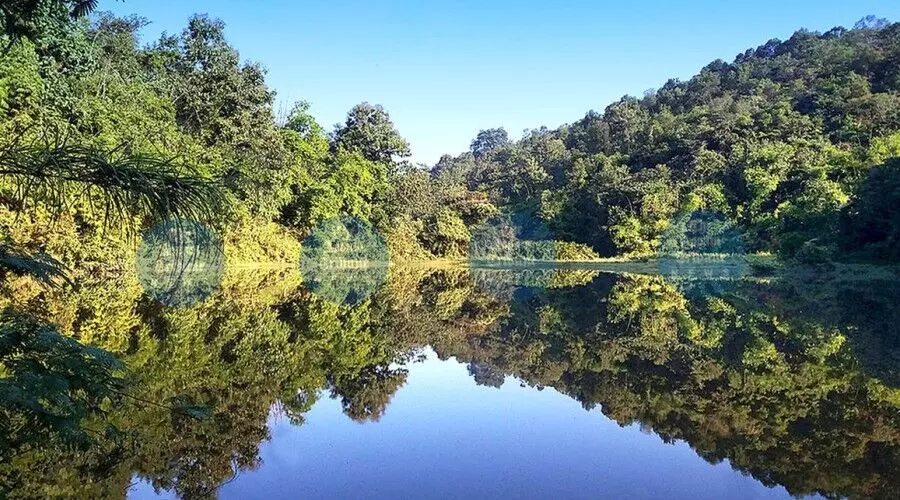
Amchang Wildlife Sanctuary
Guwahati, Nov 5: Nestled within the heart of Assam's capital city, Guwahati, the Amchang Wildlife Sanctuary stands as one of the State's most significant natural treasures.
Covering an area of 78.64 square kilometres, this lush, hilly sanctuary not only serves as a refuge for diverse wildlife but also acts as the green heart and protective shield of the rapidly expanding metropolis.
The sanctuary was formed by merging three reserve forest areas: South Amchang Reserve Forest, Amchang Reserve Forest and Khanapara Reserve Forest.
These were officially declared as reserve forests in 1953, 1972 and 1991 respcetively. The South Amchang forest covers 15.50 sq. km, Amchang 53.18 sq. km and Khaпарата 9.96 sq. km.
Responding to the persisent demand of nature lovers and wildlife enthusiasts and with the goodwill of the Assam Forest Department and government, these forests were unified and officially declared as the Amchang Wildlife Sanctuary on June 19, 2004.
A key role in this achievement was played by the non-government environmental organisation "Early Birds, led by its president Moloy Baruah, who documented the movement in his book Aranyor Suwodi Maat.
Following its declaration, the sanctuary was divided into two forest ranges for administrative convenience - the Amchang Wildlife Range (Borda) and the Khanapara Wildlife Range (10th Mile).
The hills of Amchang extend up to the forested slopes of Meghalaya, forming a natural ecological corridor. The road connecting Satgaon to Sonapur via Amching Jorabat divides the sanctuary into two forest sections.
In earlier times, the present Narengi Army Cantonment area was an open grassland rich in shrubs and creepers, while Panjabari was full of wetlands and small water bodies.
In those days, herds of elephants roamed freely across these plains and hills.
The region also functioned as an elephant corridor, allowing elephants to travel from Sonapur and Marakdola Reserve Forests in the east to the Meghalaya Hills in the south, and towards the Rani Forest and Deepor Beel in the west.
Elephants once bathed and played in Deepor Beela sign of the area's healthy ecosystem. However, today the surroundings of these hills are heavily populated.
Human settlements have gradually spread into forest land. Trees have been cut down. forest plantations cleared and open areas occupied for construction. These encroachments have posed serious threats to the ecological balance and survival of Amchang's wildlife.
Amchang Wildlife Sanctuary is home to a wide range of rare and endangered animal species.
Among the mammals found here are Asian elephants, leopards, fishing cat, Asian palm civet, tadpole, different species of monkeys, gaur or Indian bison, sambar, barking deer, porcupines, mongooses, wild pigs, rabbit, flying squirrel and otter.
The sanctuary also supports several species of reptiles, including monitor lizards, pythons, and various snakes, along with numerous species of butterflies, moths and insects.
For bird lovers, Amchang is a paradise. It shelters both resident and migratory birds such a jungle fowl, doves, egrets, teals, partridges, woodpeckers, hornbills, kingfishers, bulbuls and many others.
The vegetation of Amchang is equally rich and diverse. The forest is dominated by teak, white iris, axle wood, terminalia, wild java plum, elephant rope tree, beechwood, bitter champa, black dammer tree, cluster fig and arjun trees.
The area is also known for its abundance of medicinal plants, which adds great ecological and scientific value. This greenery not only sustains local biodiversity but also enhances the aesthetic charm and environmental health of Guwahati city.
For the people of Guwahati, the presence of Amchang is a blessing. The sanctuary's vast greenery provides fresh air, regulates temperature and prevents soil erosion and floods acting as a natural barrier and "green lungs of the city.
It also maintains ecological balance and ensures the survival of countless life forms.
However, the increasing population pressure, deforestation, industrialisation and urban expansion are shrinking this forested land at an alarming rate. If this destruction continues, the city may soon lose its natural shield, resulting in ecological disasters such as floods, air pollution and loss of bio-diversity.
The survival of Guwahati's citizens is deeply connected to the survival of Amchang. Protecting it is not merely a matter of conservation, it is a necessity for the city's own existence.
Amchang Wildlife Sanctuarv truly deserves to be called the heart of Guwahati. Its hills and forests breathe life into the city, nurturing both nature and humankind.
Yet, its future remains uncertain amid rapid urbanisation and encroachment. If Guwahati is to remain green, healthy and sustainable, the green cover of Amchang mast be preserved at all costs.
Citizens, government bodies and environmental organisations must unite to ensure its protection, conservation and long-term sustainability.
Gautam Sarmah