
‘Who is Himanta?’: Gogoi revives old line as Congress sets tribal agenda for 2026
Tribal land, identity & representation take centre stage as Congress prepares 2026 manifesto around key ST demands
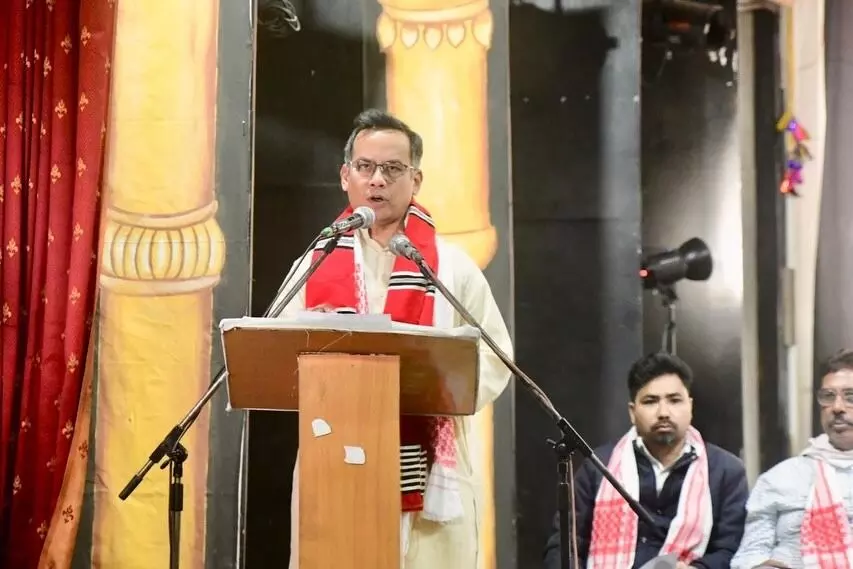
A file image of Assam Congress chief, Gaurav Gogoi. (Photo:Meta)
Guwahati, Jan 11: With the 2026 Assam Assembly elections inching closer, the political temperature in the state is steadily rising, with the Congress and the ruling Bharatiya Janata Party (BJP) sharpening their attacks and counter-attacks.
Setting the tone for an increasingly combative campaign, Assam Pradesh Congress Committee (APCC) president Gaurav Gogoi, on Sunday, took a direct swipe at Chief Minister Himanta Biswa Sarma, invoking a line once famously used by his father and former chief minister Tarun Gogoi.
Addressing a joining programme at the Manabendra Sarma Complex in Guwahati, Gogoi said that the people of Assam would soon come together to ask, “Who is Himanta Biswa Sarma?”
Recalling his father’s past political rhetoric, Gogoi told the gathering that Tarun Gogoi’s question, aimed at an AIUDF leader at the time, had struck a chord with the public.
“Once the people of Assam unite against fear and syndicate politics, they too will ask ‘who is Himanta Biswa Sarma?’” he said. The Congress leader added that the party’s effort is to make “the people the king”, asserting that true power lies with citizens rather than individuals.
The remarks drew a swift and sharp response from the BJP. Party leader Alokmoni Bhattacharya dismissed the comparison and strongly defended the chief minister, calling Sarma “the best chief minister Assam has ever had”.
“Is Badaruddin Ajmal the same as Himanta Biswa Sarma? No,” Bhattacharya said, adding that Sarma’s track record on development and cultural preservation was well known to the people of Assam.
He also questioned the Congress leadership’s connect with Assamese identity, arguing that voters were aware of what the BJP government had delivered. “How can one who can’t speak Assamese properly save Assam?” he asked.
Even as the war of words intensified, the Congress moved to underline its policy focus, particularly on tribal issues, by formally receiving a comprehensive report prepared by a Core Scheduled Tribe (ST) Study Group.
The report is expected to play a key role in shaping the party’s manifesto for the 2026 elections.
According to the Congress, the group undertook extensive field-level engagement across constituencies, holding consultations with tribal organisations, NGOs and individuals from communities including Rabha, Garo, Bodo, Hajong, Amri Karbi, Tiwa and Mising.
The report identifies alleged violations of tribal land and forest rights as a core concern, citing instances of land transfer to non-ST and non-local interests, leading to livelihood insecurity and economic marginalisation
Among the key demands recommended for inclusion in the Congress manifesto are strict enforcement of laws protecting tribal land, belts and blocks, the grant of bhumi patta to genuine tribal forest dwellers, establishment of a Tribal University in Assam, ST status for the Amri Karbi community, inclusion of the remaining 312 Bodo revenue villages under the Bodo Kachari Welfare Autonomous Council, and the creation of Development Councils for plains tribal groups currently excluded from such frameworks.
The APCC said the report has been formally submitted to the party president and will form a critical foundation for crafting an inclusive and tribal-focused manifesto ahead of 2026 Assembly polls.