
‘Taarikh’ explores lingering aftermath of 2008 blasts through one man’s loss
Taarikh, directed by Himjyoti Talukdar, explores grief and closure through the story of a father’s search for his missing son after the 2008 Assam serial blasts
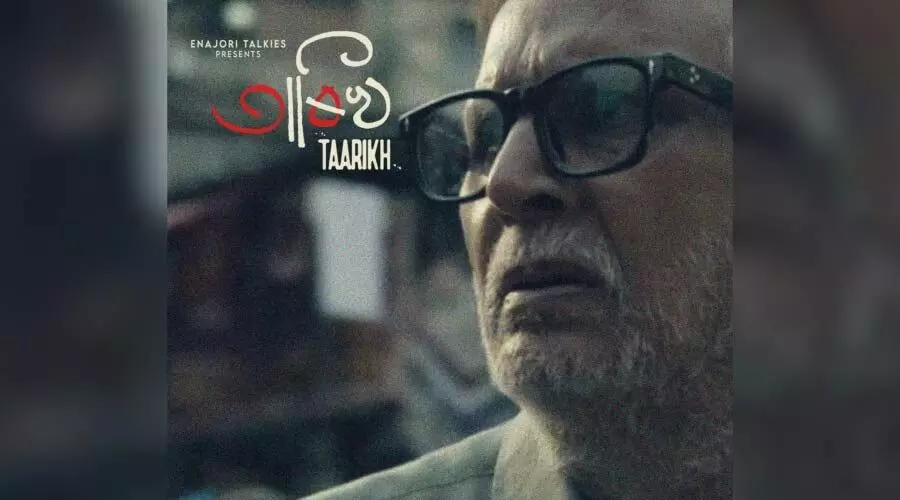
A poster of Taarikh (Photo - @k_hazarika1102 / X)
The memory of the serial bomb blasts of October 30, 2008 has, for many of us, remained fresh in our consciousness. Personally, there is a little ticker that goes off for me every time I pass under the Ganeshguri flyover. That is why, for a whole generation of Assamese people, Taarikh comes with very personal resonances.
It is these very resonances that the filmmakers are able to tap into -through a cinematic exploration of individualised memories of loss and trauma. The young team of Taarikh did not have these very personal reference points, so they must have done fairly intensive research into the people's experiences to weave the narrative that carries forward the film.
At the script level, the film unravels, bit by bit, an individual story of loss that only towards the end connects with similar stories, and thereby represents the collective trauma in the wake of terror attacks. At no point does the film enter into the political arena; this is a film that is tightly strung, and builds to its climax through layer upon layer of a single protagonist's silent struggle to come to a sense of closure. But the singularity resonates.
Arun Nath essays the role of Durlav Dutta who writes letters to the chief minister every day, asking for the whereabouts of his missing son; delivers the letters to the local thana where a very humane officer receives it. There isn't much verbalisation: just very vocal cinema helmed by Himjyoti Talukdar through lyrically crafted frames by the talented Annirudha Baruah, the meticulous soundtrack by Debojit Gayan, the unobtrusive body language of the actors and the evocative music by Tarali Sarma that recreate the illusive, unsaid void that the protagonist's life is reduced to.
The narrative is carried to its resolution through the intervention of a journalist, played with finesse by the ageing protagonist while he is looking for a story. The connection is immediate, and we understand why only at the end of the film.
Death is a nothingness but living beings still require the materiality of the body to come to terms with it and finally accept its finality. This is the premise that drives the story, and helps in finding a workable resolution.
The carefully thought out visualisations dwell on the motions of life that must continue; the old man wakes up every morning, has his tea, writes his letter, and walks down to deliver it never uttering a single word. He doesn't have to; his colossal loss is deafening. Arun Nath outdoes himself, frame after frame as he moves toward his final heartbreak.
The manner in which the camera, the sound and the actors work in tandem with the cinematic design is what makes Taarikh such a gem of a film. Nothing is over it just flows like its themes of life and dying and the human subconscious that must learn to deal with a terrible world.
But not all of humanity is found wanting; the film holds up a picture of a very caring community too, as Dutta is looked after robustly by the household help, played by Swagata Bharali and the local mechanic (Sanjib Sarma) who turns up just at the right moments. In fact, one of the most touching moments of the film comes by way of the mechanic helping the old man as he struggles to pull on his sandals as he whisks him away on his scooter.
The everyday business of life continues, a little girl sits on the table with her colouring book, and her mother struggles with a broken mixer in the kitchen. All of which establish the natural rhythms of life that have set in, upset from time to time by the actions of the silent old man. The journalist manages to uncover the backstory, and a lovely sequence with the father-son duo is unleashed on the audience to make the loss subterranean up to now real, tangible and palpable.
It is here that the social-realism of the script kicks in, and a psychiatric intervention helps to achieve both closure and catharsis. The script delivers a deft surprise at the end, but I will not be the spoiler here; suffice to say that there is a neat little connection that is made that ends the film on a very poignant note.
Assamese cinema has of late been delivering an interesting array of offerings that range from out and out commercial hits to small but powerful films like this one. This is hopeful news for both the film-makers and film-goers in the State, and one dreams of a time when we are spoilt for choice. One must, in the meantime, laud the efforts of this young breed of filmmakers who deliver films like Tarikh.
- Asha Kuthari Chaudhuri