
Siu-ka-pha's legacy & rise of Ahom kingdom across Brahmaputra valley
Ahom leader Siu-ka-pha arrived in 1228 and unified the Brahmaputra Valley, laying the foundations of Assam’s heritage and a harmonious society
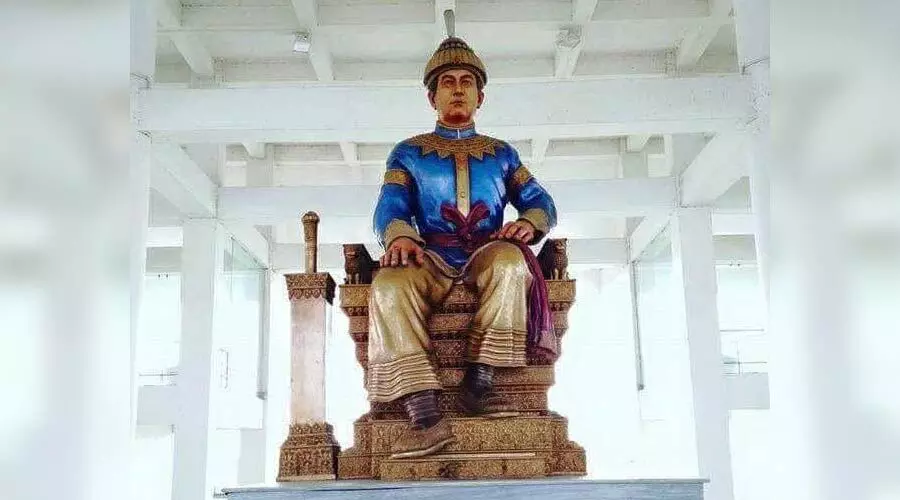
Siu-ka-pha, founder of Ahom kingdom (Photo - @GauravGogoiAsm / X)
In the 13th century, Assam witnessed the arrival by a visionary prince who went on to establish the Ahom kingdom and pave the way for a 600-year rule by the Ahoms-a grandeur so alluring that one cannot stop praising the legacy it up holds.
The land of Mung-dun-sun-kham, as it was called by the Tai-Shans later, witnessed the coming of Siu-ka-pha, a shrewd diplomat and a mature politician, who was accompanied by 300 horsemen, 1,080 soldiers, numerous officials, royal priests, and so on.
The Ahoms did not bring their wives along with them, but took one from the country they conquered. When Siu-ka-pha invaded the land of Saumar, it was in habited by the Morans, Mataks, Borahis, and small ruling parties. Eventually, they were conciliated by dint of Siu-ka-pha's might and brilliance.
Apart from introducing numerous rituals, Siu-ka-pha also showed respect for the indigenous languages. Instead of imposing his own language, he chose to respect the language of the people, while using his own language only in religious scriptures and selected books.
Had Siu-ka-pha not stepped into Assam, the land would not have witnessed the valour of the Ahoms in the battle of Saraighat in 1671 against the Mughals under Lachit Borphukan, whose bravery won the praise of even the then Mughal general Ram Singh.
Had Siu-ka-pha not founded the Ahom kingdom here, Assam would not have witnessed the architectural marvels that are still standing tall, bearing the imprints of the glorious Ahom rule.
Born in Maulung, Upper Burma, Siu-ka-pha left his homeland in 1215 AD and reached the Brahmaputra Valley on December 2, 1228. He called their small kingdom Mung-dun-sun-kham, meaning, a country full of golden gardens.
He hailed from the Shan dynasty of South-east Asia. The Shans first inhabited a land named Tyai-Shan on the bank of the river Tarim, which flowed to the north of Mongolia and China. They migrated to China in the 5th century AD and then to Mungrimungram in the Yun-nan province of China.
The Ahoms claim that it was in Mungrimungram that Khunlai, their youngest progenitor, ruled his kingdom. Siu-ka-pha finally Charaida in 1253 and made it his capital. After ruling for 39 years, he died in 1268.
Between 1228 and 1819, as many as 39 kings ruled Assam except for two brief periods from 1376 to 1380 and again from 1389 to 1397 - when 'Borgohain' and 'Buragohain', the counsellor posts created by Siu-ka-pha for administrative efficiency, had to rule in the absence of a king.
It is interesting to note that Siu-ka-pha did not come as a conqueror but as a noble in search of agricultural tracts. SL Baruah in A Comprehensive History of Assam notes Siu-ka-pha's negotiation attitude in the way he addressed the local communities.
"You are the hosts, the natives of the land; and we, the guests, are coming from the upcountry. You should introduce us to the local people."
Such amiable behaviour requires political acumen, visionary insight and an indomitable spirit, which Siu-ka-pha possessed aplenty.
He integrated numerous tribes under his rule in a harmonious manner, although he resorted to extreme measures when necessary.
Siu-ka-pha has given us the historical chronicles or Buranjis, without which past events would have remained shrouded in mystery.
The Ahom marriage system chaklang is a time-honoured part of Assam's heritage, while the mound burial system, called maidams, received UNESCO World Heritage Site status last year.
By uniting the politically fragmented Brahmaputra Valley, Siu-ka-pha turned his dream of 'Bor Asom' into reality.
The celebration of Asom Divas every year on December 2 since 1996, commemorating the arrival of Siu-ka-pha in Assam, has revitalised the spirit of every Assamese. It speaks about reconciliation against rebellion, peace against chaos, amity against enmity, confidence against cowardice, unity against division, protection against domination, and love against hatred.
What seems to be more important on this auspicious occasion of Asom Divas is not just drawing trajectories of Siu-ka-pha's life but to imagine what Assam would have looked like in the absence of this great ruler.
It is only then that we can draw a conclusion that we would not have had a society as harmonious as it is today, and Assam would not have witnessed the amity and plurality that it boasts now without the principles taught by Siu-ka-pha.