
Rabindranath Thakur Vishwavidyalaya: Assam’s emerging hub of culture, innovation, & education
With strong leadership and inclusivity, research, and cultural preservation, it aims to be a model State university in Assam
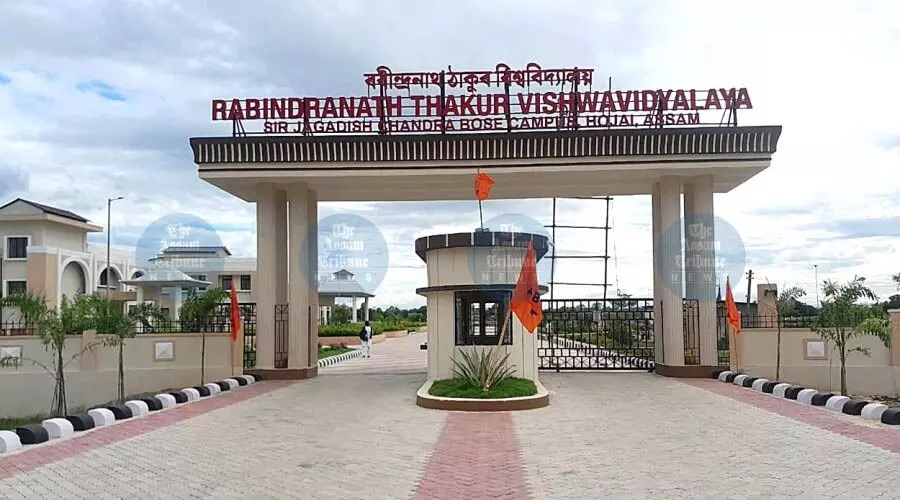
Rabindranath Thakur Vishwavidyalaya (AT Image)
Rabindranath Thakur Vishwavidyalaya, located in Hojai, is one of the newest State universities in the region. Born out of the historic Hojai College, which was established in 1964, it was elevated to university status through the Rabindranath Tagore University Act XXX-IV of 2017 and began functioning as a full-fledged university in 2019.
Named after Gurudev Rabindranath Tagore, the institution carries the weight of a legacy that blends poetry, philosophy, education and reform. From its inception, the university has sought to position itself as an academic hub for central Assam and beyond. Offering under graduate, postgraduate and doctoral programmes across 16 departments in Humanities and Social Sciences, Natural and Mathematical Sciences and Commerce.
It caters to both regular students and those pursuing distance education through KKHSOU and IGNOU. This inclusivity reflects its mission to reach learners who cannot attend traditional classes.
The university functions through a multi-campus model. The Srimanta Sankaradeva Campus in its original base of Hoai College, remains the historic heart of the institution, while the Sir Jagadish Chandra Bose Campus at Sagarbasti, covering 80 bighas of land, is emerging as a state-of-the-art facility designed to meet future academic and cultural needs.
This new campus, set to be inaugurated by Chief Minister Himanta Biswa Sarma on September 2 next, represents the modern face of the Vishwavidyalnya. The Jogijan Campus, being developed on the site of an incomplete ITI College, currently offers only Arts subjects. Beyond Hojai district, the Shombhodjan Fonglo Campus in Dima Hasao district extends higher education to one of Assam's most remote and culturally diverse regions, ensuring representation of tribal and rural communities.
The most striking strength of Rabindranath Thakur Vishwavidyalaya lies in its blend of tradition and innovation. Philosophically inspired by both Rabindranath Tagore and Srimanta Sankaradeva, the university's vision extends beyond technical skill building to encompass compassion, cultural preservation, environmental awareness, and ethical citizenship.
The leadership team is another asset. The university's vice chancellor, Prof Manabendra Dutta Choudhury, a distinguished life scientist, Commonwealth Fellow and Fellow of the Royal Society of Biology in the UK, brings global academic exposure and a commitment to interdisciplinary research, particularly in the tribal and ethnic cultures of Northeast India.
His emphasis on education as a tool for social harmony aligns well with Tagorean ideals. Registrar in-charge Dr Shekhar Kanti Sarkar reinforces this vision through an administrative philosophy centered on transparency, digitisation, decentralisation, and student centric governance.
The geographical spread of the university offers op-portunitics for regional integration. Its presence in both urban and remote rural contexts provides scope to address diverse educational needs, from modern research programmes to community-based skill initiatives.
Despite its promise, Rabindranath Thakur Vishwavidyalaya faces significant challenges. As a young university, it has yet to establish a strong academic reputation, compete in research rankings or earn higher NAAC grades. Much of its infrastructure, especially at the flagship Sir Jagadish Chandra Bose Campus, is still under construction. Expansion without fully operational facilities may strain existing resources at the historic campus.
Managing four campuses spread across different lo-cations poses logistical and quality-control issues. Without consistent faculty recruitment, training, and resource allocation, there is a risk of uneven academic standards, particularly in remote areas like Dima Hasao. Another concern is the University's dependence on leadership stability.
While the current leadership is visionary, sudden administrative changes or political shifts could slow or alter its developmental trajectory. Moreover, attracting and retaining highly qualified faculty in a new institution located outside major urban centres remain a challenge.
Rabindranath Thakur Vishwavidyalaya is unique ly placed to develop as a specialised centre for Northeast Indian cultural and tribal studies, an academic niche that remains underdeveloped nationality.
By integrating Tagorean educational ideals into its curriculum and research. the university can build a distinctive identity: Partnerships with national and international institutions could accelerate its research profile, while industry collaborations could strengthen employability outcomes for graduates.
The university's ongoing work in distance education provides an excellent platform to expand digital learning across Northeast India, bridging educational gaps in remote areas.
Rabindranath Thakur Vishwavidyalaya is a promising but still evolving institution. Its leadership's commitment to ethics, inclusivity, and cultural preservation is commendable. However, its success will depend on how effectively vision translates into measurable outcomes, research output, infrastructural readiness, and academic excellence across all campuses.
If it leverages its cultural heritage, ensures balanced campus development, and sustains strong academic leadership, Rabindranath Thakur Vishwavidyalaya has the potential to emerge as a model State university in Assam, serving not only as a seat of learning but also as a force for socio-cultural and environmental enrichment.