
Provincialisation of BTR and Bodo schools take center stage in Assembly
The discussion during Question Hour focused on Clause 6.3 of the Bodo Accord, provincialisation of schools in BTR and Bodo-medium institutions outside BTC
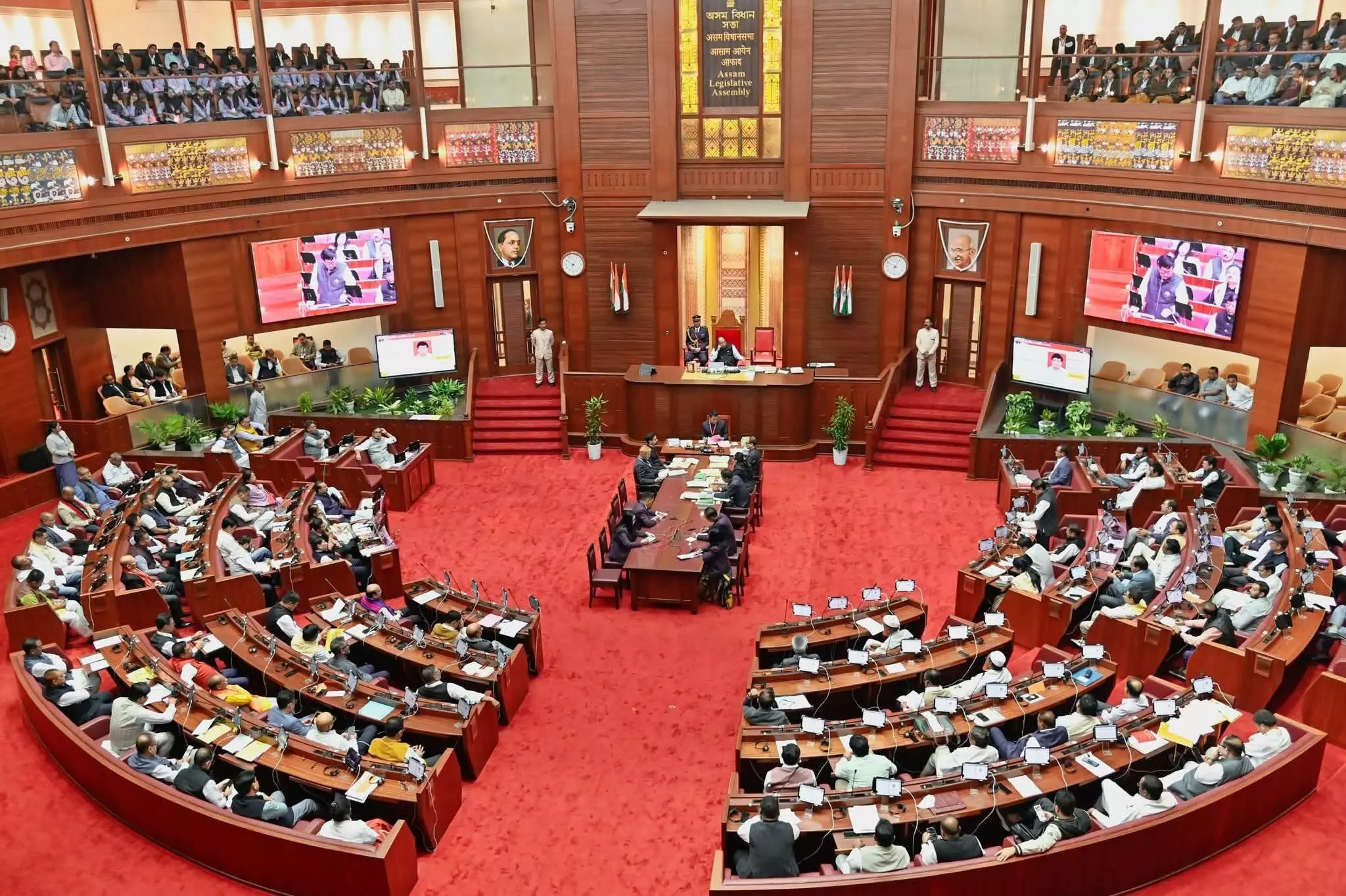
A file image of the Assam legislative Assembly session (Photo:@AjantaNeog/X)
Guwahati, Nov 27: The implementation of Clause 6.3 of the Bodo Accord and the long-pending issue of provincialisation of schools in the Bodoland Territorial Region (BTR) and Bodo-medium schools outside BTC dominated another segment of the Question Hour in the Assam Assembly, with members seeking clarity on the steps taken by the government.
Raising the issue, Lawrence Islari recalled that the BTR Accord was the outcome of extensive discussions involving the Assam and Central governments and was aimed at restoring peace in a region that had witnessed years of conflict.
He pointed out that prolonged unrest had severely hampered development, including in the education sector, and that schools in BTR remained without provincialisation.
“BTR remained an area of conflict for years, and during that time there was no proper development in education and other sectors. Provincialisation of schools could not take place. Clause 6.3 of the Bodo Accord clearly mentions special consideration for schools in BTR. We need to know what steps have been taken regarding this,” Islari said.
Responding to the query, Education Minister Ranoj Pegu explained that the existing provincialisation law provides for its applicability to Sixth Schedule areas through official notification. He said the government is open to extending the law to BTC areas, but practical challenges remain due to the absence of required documents and criteria in many schools, largely because of the region’s troubled past.
“The provincialisation law clearly states that its application to Sixth Schedule areas is done through notification. If BTC wants us to apply it, we can do so. However, due to years of conflict, many schools do not possess the necessary documents or fulfil the criteria for provincialisation,” Pegu said.
He added that the government is exploring alternative mechanisms and emphasised that BTC has the authority to enact its own provincialisation law for schools in the region.
“The BTC has the right to create its own provincialisation law. Once such a law is framed, and if any school comes under its purview, we will immediately notify and provincialise them with full support from the Assam government,” Pegu stated.
Robiram Narzary further expanded the issue by highlighting that Clause 6.3 of the Bodo Accord is not limited to schools within BTC alone.
He noted that it also refers to Bodo-medium schools in districts such as Lakhimpur, Goalpara, Dhemaji, Golaghat and Sivasagar, many of which continue to function in poor conditions.
“Provincialisation is not only about BTC schools. The Bodo-medium schools outside BTC are also covered under the Accord. Their condition is extremely bad, and if the existing Assam education law does not accommodate them, then as per the Accord, they should still be provincialised,” Narzary said.
Clarifying this aspect, Pegu informed the House that the Bodoland Territorial Council is currently working on compiling a detailed report on the issues and conditions of Bodo-medium schools located outside BTC areas. He, however, underlined that the government is bound by legal provisions that restrict eligibility based on the date of establishment.
“The Bodoland Territorial Council is preparing a list of the issues and conditions of Bodo-medium schools outside BTC. But I would like to clarify that only those schools established before January 1, 2006, fall under the existing law. I cannot change this legal provision,” Pegu said.
He reiterated that while the government recognises the concerns raised under the Bodo Accord, any move towards provincialisation must align with the current legal framework unless new legislation is introduced by BTC for its jurisdiction.