
‘Miya’ row: Assam CM defends usage, denies communal intent, cites 2005 SC ruling
Citing the 2005 IMDT ruling, Sarma says his terminology aligns with Supreme Court observations on Assam
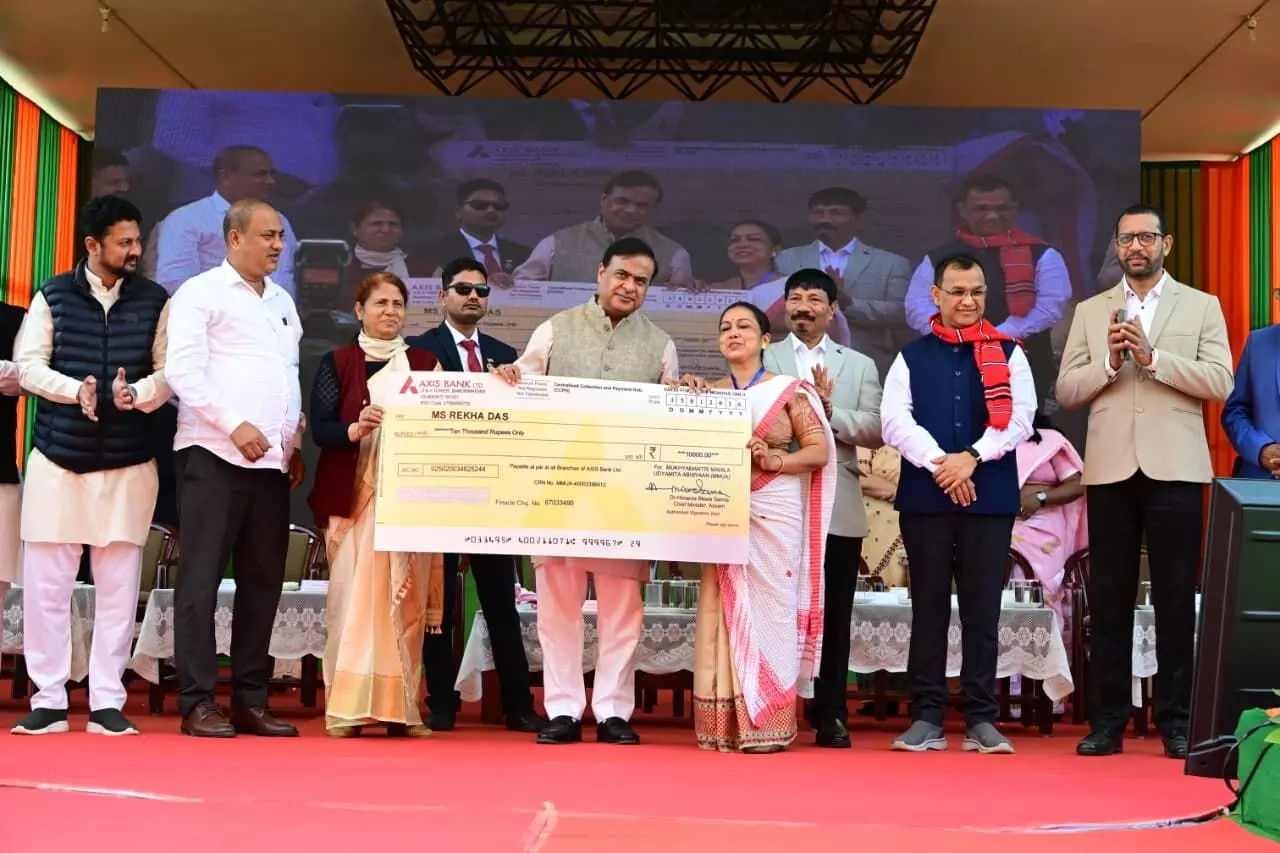
CM Sarma during the distribution of MMUA seed-capital in Golaghat, on Thursday. (Photo:@CMOfficeAssam/X)
Guwahati, Jan 29: With the term “miya” emerging as a political flashpoint in Assam ahead of the 2026 Assembly elections, Chief Minister Himanta Biswa Sarma, on Thursday, said he is not deliberately coining or imposing the term.
Speaking at a welfare scheme and seed-capital distribution programme in Golaghat, Sarma said, “I have not given them (illegal immigrants) this name. They themselves call each other miya, and they write miya poetry.”
Sarma further argued that his choice of words was aligned with terminology used by the Supreme Court, particularly in the landmark July 12, 2005 judgment in Sarbananda Sonowal v. Union of India, which struck down the Illegal Migrants (Determination by Tribunals) Act, 1983, as unconstitutional.
“A Supreme Court judgment speaks about Bangladesh nationals targeting Assam and uses the term ‘Muslim’. I am not using that term because it would bring Assamese Muslim communities under its purview. Being in politics, I am using the word ‘miya’,” Sarma said.
He claimed the apex court had repeatedly referred to demographic changes in Assam while highlighting illegal immigration from Bangladesh.
“The Supreme Court presented data showing how the percentage of Bangladesh nationals increased in Assam. Districts that once had 10% Muslim population now have 60%. These are questions raised by the Supreme Court itself,” he said.
The Chief Minister also cited historical figures, including Assam’s first Chief Minister Gopinath Bordoloi, litterateur Ambikagiri Raichoudhury and former Chief Minister Bishnuram Medhi, claiming that similar terminology had been used in earlier decades.
“Even if I say 5% of what Bordoloi or Medhi said, there will be chaos today. If Bordoloi was wrong, then the Congress must say their Chief Minister was wrong. Such words were also used by Hiren Gohain in 1992,” Sarma said.
Referring to districts such as Dhubri, Barpeta, Nagaon and Morigaon, the Chief Minister said the impact of illegal immigration was evident on the ground.
Highlighting the gravity of the illegal immigrants’ influx into Assam, Sarma said BJP leader Biswajit Phukan had flagged the issue in Golaghat.
“Biswajit Phukan told me that without eviction drives, 16,000 additional names would have appeared on electoral rolls,” he said.
Sarma’s remarks come amid sharp criticism from Opposition parties, including the Congress, Raijor Dal and the All India United Democratic Front (AIUDF), which have accused him of deliberately communalising politics ahead of the Assembly polls.
Later, in a social media post, the Chief Minister said the government’s actions were not directed against any religion or Indian citizen.
“Our effort is not against any religion or any Indian citizen. Our effort is to protect Assam’s identity, security and future, exactly as the Supreme Court cautioned the nation to do. Ignoring that warning would be the real injustice—to Assam and to India,” he wrote.