
Majuli satra turns open classroom as NSD students learn Assam's timeless mask art
Using bamboo, cane & clay, NSD students explored state's ancient mask-making tradition during a 15-day workshop at North Kamalabari Satra
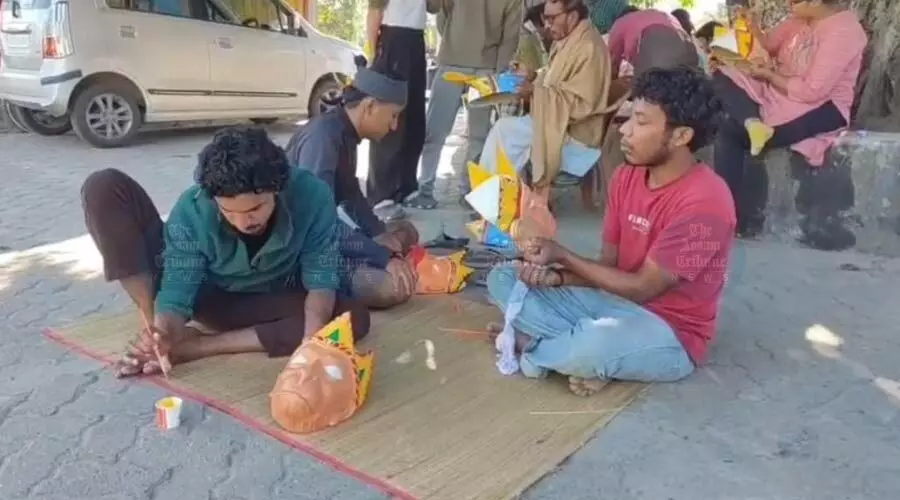
Students from NSD, Tripura learning Assam’s mask making art in Majuli (Photo: AT)
Majuli, Dec 17: For the past 15 days, rare and evocative scenes have unfolded at North Kamalabari Satra in Majuli. Under the shade of trees, National School of Drama, Tripura, students have been learning Assam’s centuries-old mask-making tradition on the banks of the Brahmaputra.
Young theatre practitioners from Punjab, Delhi, Maharashtra, Uttar Pradesh, West Bengal, Uttarakhand, Himachal Pradesh, Madhya Pradesh and Tripura immersed themselves in the traditional art under the guidance of Padma Shri awardee and master artisan Hem chandra Goswami.
Using bamboo, cane, clay and other natural materials, the students crafted masks rooted in Assam’s rich cultural heritage.
Held in the serene spiritual setting of the satra, the workshop brought alive the guru–shishya tradition.
Under the shade of trees that doubled as an open-air classroom, students created masks of mythological gods and demons; an essential element of Assam’s Bhaona tradition.
Speaking on the concluding day of the workshop on Wednesday, Goswami said the experience reaffirmed the national relevance of Assam’s traditional art forms.
“The workshop went on for 15 days, and it felt very good. NSD students from different states came here to learn the mask-making tradition. Theatre requires masks, and that is why they are learning this process,” he said.
He added that the art form, introduced by Mahapurush Srimanta Sankardeva, has long been on the path to global recognition. “Today is the concluding day, and today all the masks will come to life,” Goswami said.
Highlighting the sustainability of the tradition, Goswami noted that Assam’s masks stand apart because of their eco-friendly materials.
“Many states have their own mask traditions, but Assam’s masks are unique. They are made from bamboo, cane, clay and cow dung. This pollution-free tradition is over 500 years old,” he said.
For the students, the experience went far beyond technical training. A student from Punjab said the environment of the satra deeply influenced their creative process.
“It felt really good. The energy here helps us work better. We never imagined we would be making masks one day. We feel blessed to learn from such gurus. We will take these masks home — shaped and touched by the gurus of the satra,” the student said.
Another student from Delhi described the workshop as a moment of pride not just for Assam, but for the entire country.
“This is something to be proud of; a 500-year-old tradition being preserved. Our guru is a Padma Shri awardee. When Guru ji works, it feels like meditation. This is bhakti,” the student said, acknowledging that learning regional folk and classical traditions is a mandatory part of NSD’s curriculum.