
Majuli erosion control measures hit by unstable soil, Brahmaputra Board orders studies
The Brahmaputra Board has launched fresh geotechnical and hydrological studies as Phase-V protection works begin.
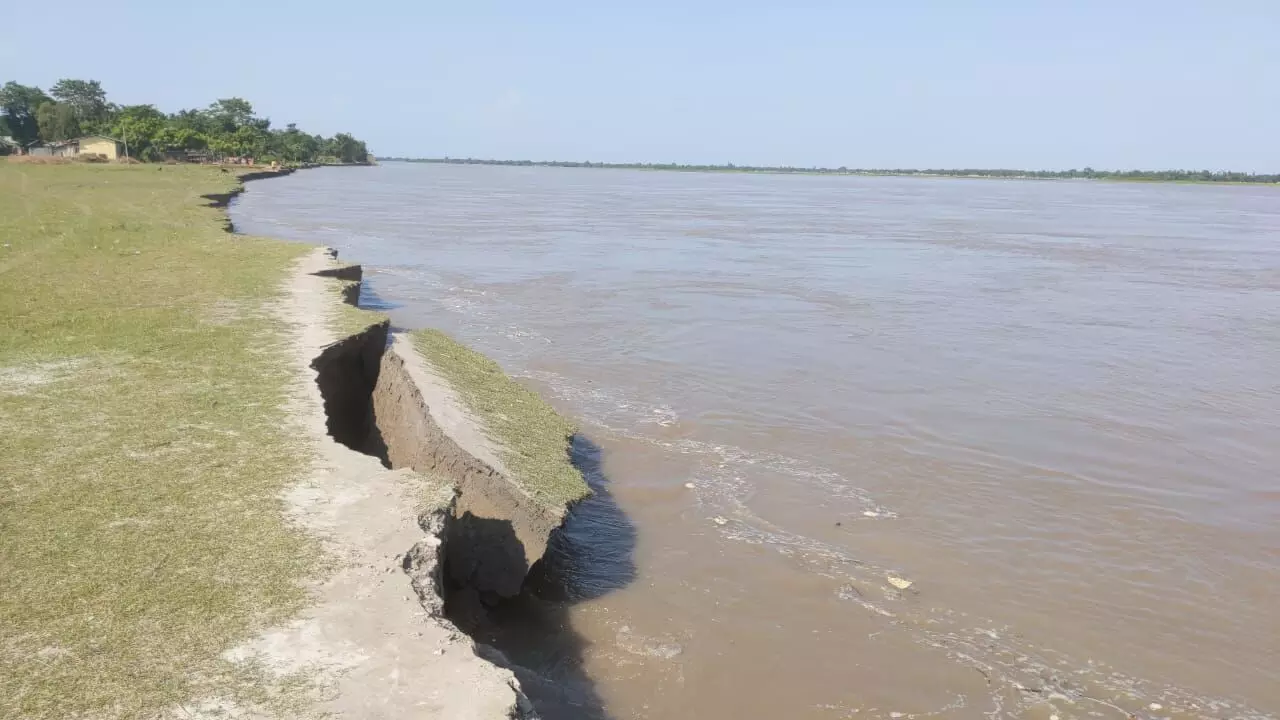
The Brahmaputra Board has launched fresh geotechnical and hydrological studies as Phase-V protection works begin.
Guwahati, Dec 14: Despite the reclamation of over 27 sq km of land in Majuli, unstable soil in some stretches is impeding the bank protection works, prompting the Brahmaputra Board to initiate fresh geotechnical and hydrological studies to chalk out a resolution plan.
This comes even as the Board rolls out the fifth phase of the protection works, focusing on 20 vulnerable stretches.
The ‘Protection of Majuli Island from Flood and Erosion of River Brahmaputra (Phase-V)’, involving an estimated cost of Rs 56.34 crore, seeks to implement bank protection measures using PSC porcupines at multiple vulnerable locations across the island.
“Phase V comprises of 20 works. We expect to complete them in one year’s time. While we do that we are also planning for the next phase,” Union Water Resources Secretary VL Kantha Rao said on the sidelines of a review meeting here.
Rao said that the he met officials from the State Government and it was agreed that a joint action plan will be executed together in the problematic stretches.
According to a satellite-imagery based study by the Pune-based Central Water and Power Research Station (CWPRS), continuous erosion in the region near the confluence of the Subansiri and Brahmaputra rivers was observed throughout the study period (1986-2023), particularly Major Chapori NC, extending from Katoni Goan Na Satra to Banpurai.
Further, major deposition was observed in between Ratanpur Miri Gaon to Kathal Khowa Pam, whereas the region around Kamalabari eroded initially and deposited during 2018-2023. A significant deposition of approximately 27.47 sq km was observed near Kamalabari during the period from 2021 to 2022.
“The yearly analysis from 2018 to 2023 indicated that there was no significant migration in the river reach, except for the area near Kamalabari. A significant deposition of approximately 27.47 sq km was observed near Kamalabari during 2021-22,” excerpts of the study accessed by this correspondent revealed.
The study also analysed the effectiveness of the riverbank protection measures from 2003 to 2023, which revealed deposition and bank stabilization near Kamalabari, Bengena Ati Purona Satra and Manik Beel.
It was also observed from the analysis that the regions around Major Chapori NC (from Missamora to Kongbongchapari NC) were found to be eroding and need active intervention to stabilize the bank and control erosion. This intervention will help in the migration of the river channel to the south.
Official sources said during execution of the Phase IV works, it was observed that the stretches at Salmara, Bhakatchapori and Kordoiguri (totalling around 9 km) are marked by unstable and non-cohesive soil, and multiple attempts of bank revetment were not successful. Dredging of the river has only added to the vulnerability.
“The CWPRS is conducting further studies after which a resolution plan will be chalked out. Until then, we are going ahead with the porcupine works in 20 vulnerable stretches and spur repair works at three locations as part of the fifth phase of the project,” the sources said.
The Brahmaputra Board has implemented works worth over Rs 416 crore for the protection of the Majuli island since 2004.
Accompanied by Board’s chairman Ranbir Singh, the Water Resources Secretary, during his visit to the State, also visited Majuli to oversee the works.
The review meeting was aimed at providing a cohesive, strategic direction for basin-level development and water resource management across the region. The attendees included representatives from all basin states and State Government departments of all Northeastern states, including Sikkim, the northern part of West Bengal, the Brahmaputra Board, the Central Water Commission (CWC), the Central Ground Water Board (CGWB), and the National Institute of Hydrology (NIH).