
Internet access in Assam’s secondary, higher secondary schools jump to 53.8%
Central report shows steady growth in digital facilities; dropout rate still high at secondary level
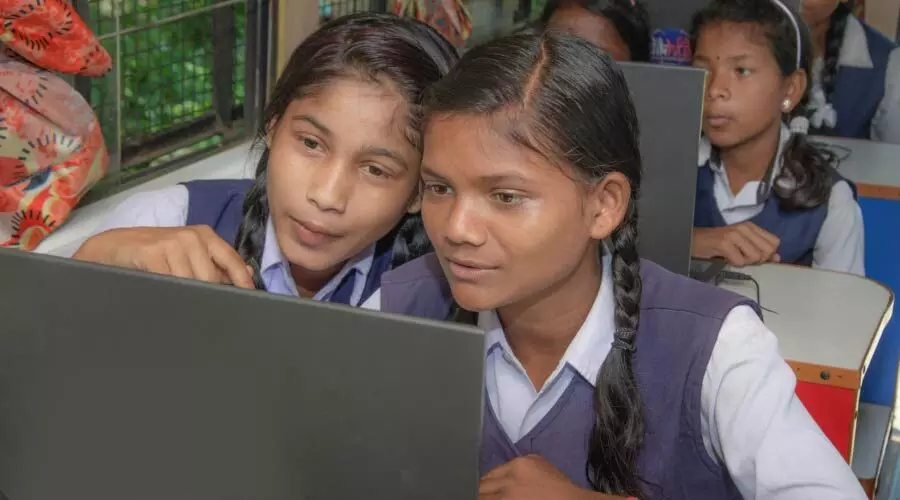
A file image of students with computers in Upper Assam. (Photo:@OilIndiaLimited/X)
Guwahati, Sept 30: The percentage of secondary and higher secondary schools in the State with internet facilities has increased substantially during recent years.
As per the latest Central government publication Children in India 2025, only 13.7 per cent of the secondary and higher secondary schools in Assam had internet facilities in 2015-16. However, that figure went up to 53.8 per cent in 2023-24.
The availability of internet facilities in such schools has witnessed an increase at a higher rate with the passage of time. From 13.7 per cent in 2015-16, it went up to 15 per cent in 2016-17; 16.4 per cent in 2017-18, 20.9 per cent in 2018-19, 22.6 per cent in 2019-20, 24.5 per cent in 2020-21, 29.8 per cent in 2021-22, and 34.6 per cent in 2022-23, before touching 53.8 per cent in 2023-24.
As per the data, there were a total of 55,283 schools in Assam under the NEP structure in 2024-25. Among these, 35,866 were foundational and preparatory schools, 9,116 were middle schools, and 10,301 were secondary schools.
Library/book bank/reading corner facility was available in 51,763 schools of the State. There were playgrounds in 45,594 schools, functional girls toilets in 52,065 schools, functional boys toilets in 51,285 schools, functional electricity in 49,092 schools, computer facility in 43,515 schools, drinking water in 54,167 schools, and hand-wash facility in 51,426 schools.
The average expenditure per student on school education in Assam is Rs 9,360 per annum. Item wise, the maximum expenditure of Rs 3,545 is on course fee. Items of expenditure also include transportation (Rs 2,186), uniform (Rs 1,009), textbook/stationery (Rs 1,763), and others (Rs 857).
The dropout rate in the preparatory level in 2024-25 under the NEP structure stood at 3.7, while it was 5 for middle school and 12.2 in the secondary level.
At the same time, the Pupil Teacher Ratio (PTR) was 10 at the foundational level, 11 in preparatory level, 13 in middle school level, and 15 in the secondary level.
The completion rate in Assam in 2023-24 was 67.09 per cent in grade-5, 72.86 per cent in grade-8, and 35.59 per cent in grade-12.
The gender parity index in 2024-25 under the NEP structure was 1 at the foundation level, 1.1 at preparatory level, and 1.2 each at the middle and secondary levels of education.
As per Children in India 2025, the death rate among kids in the age group of 0-4 years was 7.5 per cent in 2023 (8 in rural areas and 3.5 in urban areas) in the State. In the age group of 5-9 years, the death rate was 0.2 (rural 0.3 and urban 0.1), while the figure was 0.6 (0.6 in rural and 0.3 in urban) in the age group of 10-14 years, and 0.4 (0.5 in rural and 0.2 in urban) in the age group of 15-19 years.
The data also showed that as per nutritional status of children under the age of five years classified as malnourished according to three anthropometric indices, the rate of stunting was 35.3 per cent, while 21.7 per cent kids were classified as wasted, 32.8 per cent as underweight, and 4.5 per cent as overweight in 2019-21 (three-year average).
The percentage of children aged 6-59 months having anaemia in Assam in 2019-21 was 68.4 per cent. It was 68.6 per cent in the rural areas of the State, and 66.4 per cent in the urban areas.
The rate of iron deficiency stood at 3.5 per cent in children aged 5-9 years and 11.5 per cent among adolescents aged 10-19 years.
As per the data, a total of 153 adoptions took place in the State in 2024-25. Of these, 65 were male children and 88 were female.
In-country adoptions accounted for 150 of the total cases, and three were inter-country adoptions.
The Union Ministry of Statistics and Programme Implementation (MoSPI) has been releasing a comprehensive ad-hoc publication titled Children in India since 2008. The Children in India 2025 is the fourth such publication on the status of kids in the country.