
Goalpara pioneers effort to curb human-elephant conflict with underpass plan
Amid rising human-elephant conflicts in Goalpara, experts are testing a pilot project to condition wild elephants to use the Agia Elephant Underpass
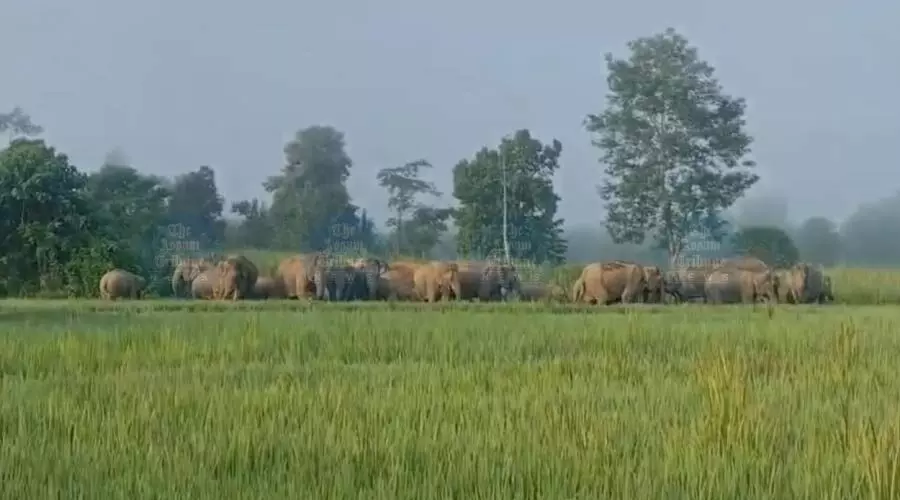
A file image of an elephant herd in a village
Goalpara, Nov 4: The image on wild elephant silhouetted against Assam's paddy fields has for long carried both majesty and menace. For centuries, elephants hove named freely across the Brahmaputra Valley, shaping culture, ecology, and folklore. Yet today, this iconic species is increasingly at the heart of a tragic conflict.
Human-elephant conflict (HEC) in Assam has escalated in recent decades, driven by shrinking forests, encroached corridors, and the pressure of infrastructure expansion. Villages in Rangjuli, Krishnai, Agia, and Lakhipur live under the shadow of recurring herd incursions, crop raids, house damage, and even fatalities.
Between 2019 and Assam lost 3 people to counters with elephants, with Goalpara consistently featuring among the most vulnerable districts. In 2024 alone at least 22 lives were lost, and many families still await compensation. For rural households dependent on paddy harvests, each raid means not just food insecurity but also a test of survival.
This article draws on the "Integrated Report on Ha-man-Elephant Conflict in Goalpara District’ and a pilot project proposal prepared for the district administration. It examines the crisis, the interventions so far, the gaps that remain, and a bold experiment to tum conflict into co-existence-conditioning elephants to safely use the Agia Elephant Underpass (EUP).
Patterns of conflict in Goalpara: Field studies reveal a predictable rhythm to the conflict. Herds, often crossing from Meghalaya, enter Goalpara's forest ranges of Rangjuli, Krishnai, and Lakhipur, especially after the monsoon when paddy ripens. Evenings and nights bring the most risk, with hers raiding fields, grain stores, or occasionally breaking through houses in search of food.
Conversations with villagers reveal a troubling truth: many fatal encounters occur not from unprovoked aggressions, but from provocation. Drunk youths or desperate farmers often chase elephants with crackers, sticks, or torches, leading to stampedes or retaliatory charges.
A tea stall owner near Agia summed it up simply: "Elephants don't disturb unless provoked. If we give them a path, they will take it."
What has been tried so far: Over the past five years, multiple interventions have been attempted, such as community solar fencing. About 67.55 km of low voltage fencing has been installed and later handed over to trained village committees. Wherever maintained, these fences have reduced crop raids, but misaligned stretches and poor up keep lave left dangerous gaps.
Secondly, local youth groups ("Gaja Mitras') have been mobilised for night patrols and herd driving. This initiative has proved effective in some hotspots, but it is hampered by hack of proper equipment and institutional support.
Thirdly, by way of early warning systems, tools like HaatiApp, police wireless, and WhatsApp groups have created communication chains, but these remain fragmented and not yet integrated into a single control desk. Fourthly, for railway accident mitigation, Al-enabled Intrusion Detection Systems have been deployed on some tracks by the Northeast Frontier Railway, though coverage is limited.
Despite these measures, the fundamental issue remains, as blocked corridors and lack of safe passage push elephants into villages, keeping the cycle of conflict alive.
Untapped potential of the Agia Underpass: In 2021, as part of National Highway expansion, an Elephant Underpass (EUP) was constructed at the Agia Flyover. In theory, it offers a safe cruising point for herds. In practice, elephants have avoided the structure entirely, retreating from the flyover and detouring into nearby villages.
Why? Experts point to elephants natural behaviour of caution. To them, the bare concrete of the underpass appears alien and unsafe. Without modifications, the EUP risks becoming an expensive but unused structure. This is where innovation comes in conditioning wild elephants to adopt the underpass as part of their natural movement.
The pilot project: A seven-day pilot project has been proposed to test whether elephants can be gently encouraged to use the Agia EUP. The methodology includes pet elephant engagement and en tails stationing a trained elephant at the underpass during daytime. The pet elephant will leave footprints, dung and odour natural signals (familiarity cues) that help the wild elephants trust the passage. The methodology includes food incentives, as bananas, jaggery, and salt will be distributed inside the underpass to encourage entry of wild elephants. Moreover, exposed concrete will be softened with hanging pots, climbing plants, and transplanted trees (dimoru, banana, Napier grass) at entry and exit points, creating a continuity of forest cover. To ensure night safety, the pet elephant will be withdrawn at night to avoid confrontation with wild herds. By way of monitoring, behavioural changes in wild herds will be systematically observed during and after the trial.
Expert voices: Padma Shree awardee Dr Kushal Konwar Sharma, popularly known as India's 'Elephant Doctor", emphasises the tole of ambience. "Elephants rely less on sight and more on smell and feel. Bare concrete makes thorn hesitant. But cover it with plants, make it feel like forest, and they will walk through," he explained.
Ajagar NGO, active in Goalpara, has suggested fodder cultivation in low-lying forest patches (such as Napier grass, "baodhan') to rеduсе сгор raids, and stronger enforcement against artificial forest fires lit to improve 'sal’ wood quality but which is destructive to elephant food sources.
Community role and awareness: The district administration recognises that no structure alone can end conflict. Community behaviour is central to achieve this goal. An urgent awareness drive is planned before the 2005 harvest season. Villagers will be sensitised to avoid provoking elephants, and alternatives like watch towers, safe shelters, and early warnings will be promoted. Schools, village committees, and loudspeaker networks will be mobilised to spread the message.
The District HEC Task force, proposed to be constituted under the DDMA, will see weekly hotspot reviews, publish a risk calendar, and ensure proper synchronisation of fence repairs, "Gaja Mitra' patrols, and awareness drives.
A roodmap beyond Goalpara: If the Agia pilot project succeeds then it can become replicable model across Assam's expanding highway and railway network. Already, several underpasses exist or are being planned in Sonitpur, Udalguri and Nagaon districts. Conditioning strategies could transform these from unused concretes to lifelines for elephants.
Moreover, the integration of technology (apps, Al-based alerts), ecology (fodder plantations), and community governance (fence O&M, awareness drives) offers a holistic pathway. Assam can show how development and conservation need not be at odds.
From fear to coexistence: The story of Goalpara is, in many ways, the story of Assam itself: a land where elephants and humans have co existed for centuries, but where rapid change has unsettled that balance.
By experimenting with innovative solutions like the Agia EUP pilot project, Goalpara is taking a bold step to rebuild trust between elephants and landscapes, and between communities and conservation authorities.
As the tea stall owner near the flyover wisely observed, "Elephants don't disturb unless provoked."
The challenge, then is simple but profound: to stop provoking, and start guiding.
If Goalpara can turn conflict into coexistence, it will not only protect lives and livelihoods but also safeguard the future of Assam’s most majestic residents – its elephants.
Sunayan Deka