
From obscurity to revival: Faith, folklore converge at Goalpara’s Mama Bhagina Ashram
Rooted in folklore of devotion, the ashram revives after decades of neglect and decline
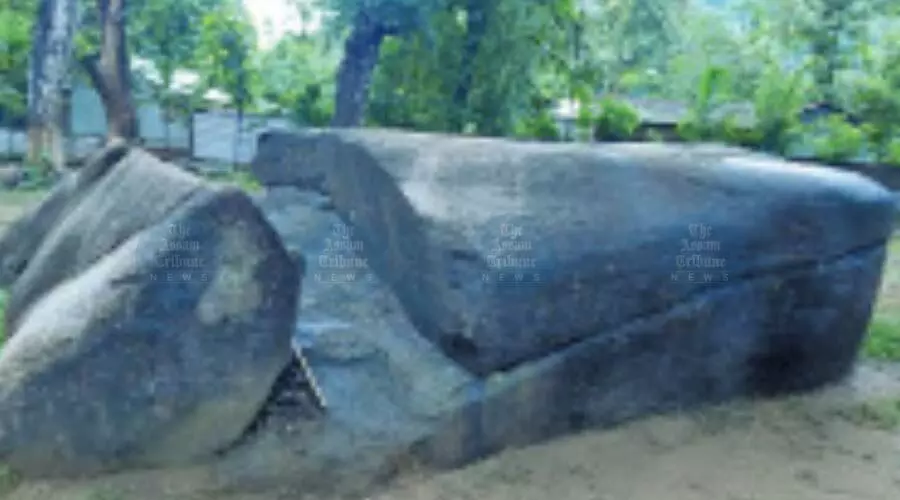
Image of the sacred stones in Goalpara (Photo: AT)
Nestled against the scenic Rakhyasini Pahar, the Mama Bhagina Ashram near Goalpara town is more than a sacred site, as it is a living repository of folklore, faith, and community memory. Once veiled in obscurity and threatened by neglect, it now stands at the threshold of revival, embodying the resilience of local traditions and the collective will to preserve Assam's cultural roots
At the heart of the ashram lies a captivating legend that explains its name. According to local folklore, the ashram is tied to the duo of Mama (maternal uncle) and Bhagina (nephew). Many decades ago, when the Rakhyasini Hills were dense with forests and teeming with dangerous animals, travellers feared encounters with tigers and bears. Yet, a peculiar belief spread through the region: as long as Mama and Bhagina were invoked together, no harm would come. In moments of peril, the cry of 'Mama-Bhagina' was said to send wild beasts fleeing, shielding devotees and wanderers alike from danger.
This enduring faith crystallised in the two sacred stones at the centre of the ashram. As per Hindu tradition, the nephew (Bhagina) is placed above the maternal uncle (Mama), a hierarchy reflected in the stones: the larger stone symbolises Bhagina, while the smaller stone represents Mama. Worshippers believe that bowing before these stones with devotion brings blessings, protection, and the fullfilment of desires.
The ashram's origins trace back to the early 20 century, between 1920 and 1935, when Sako Baba, aided by villagers from Helapakhri, Futuripara, Milonpur, and other nearby hamlets, established it as a spiritual sanctuary. Over the decades, however, the site endured periods of stagnation. The departure of guiding saints such as Sako Baba and Sita Baba left the ashram without strong leadership, paving the way for neglect and encroachment. Once spread across 52 bighas of land- as recorded in old revenue documents-the ashram has today been reduced to less than one bigha due to encroachment. In the 1980s, the District Land Advisory Board recommended safeguarding eight bighas, four kathas, and five lessas for the ashram, but the reality on the ground has remained dire.
The Mama Bhagina Ashram is not merely a religious shrine; it is a cultural hub that reflects the shared identity of the Rabha, Garo, Nepali, Baganiya (Santhal), Rajbongshi, Sutradhar, and Nath communities. Annual festivals such as Shivratri and Ekadashi Mela continue to attract devotees, even during years of decline, keeping alive a spirit of unity and reverence.
Elders recall the old gatherings, where folk tales of the protective powers of Mama and Bhagina were retold around sacred fires. These oral traditions form the backbone of community identity, sustaining faith even during times of hardship.
After nearly 25 years of inactivity, the ashram has experienced a revival under Nirmol Sutradhar, current president of the Sri Sri Mama Bhagina Ashram Porichalona Samity. His leadership has rekindled interest in the site, with devotees once again streaming in to seek blessings at the sacred stones. Prominent Figures have also emerged as guardians of this heritage. Kirti Narayan Das, president of the Sadou Goalpara Zila Satra Mahasabha and vice president of the Sodou Assam Satra Mahasabha, has repeatedly emphasised the cultural importance of the ashram. He points to its mention in Jaganath Patgiri's scholarly work Abhibhakta Goalpara Zillar Satra Aru Math Mandiror Itibitya as proof of its historical significance beyond local folkore. For Das, the ashram is not simply a local shrine but a cultural landmark deserving of recognition and protection.
Similarly, Dr. Kashyap Prakash, a senior member of the BJP's state executive, has emphasised the pressing need to reclaim the ashram's lost land and restore its rightful dignity. He has consistently highlighted that the revival of the Mama Bhagina Ashram is not merely a matter of spiritual rejuvenation but also an effort to harmonise ecological conservation with cultural preservation.
Through forest protection measures and heritage preservation programmes, officials aim not only to shield the ashram from encroachment but also to revitalse it as a vibrant cultural and spiritual centre.