
Four tech-savvy youths drive soilless farming revolution in Sualkuchi
Hydroponic setup produces fresh exotic greens & herbs year-round, supplying high-demand premium vegetables to local markets
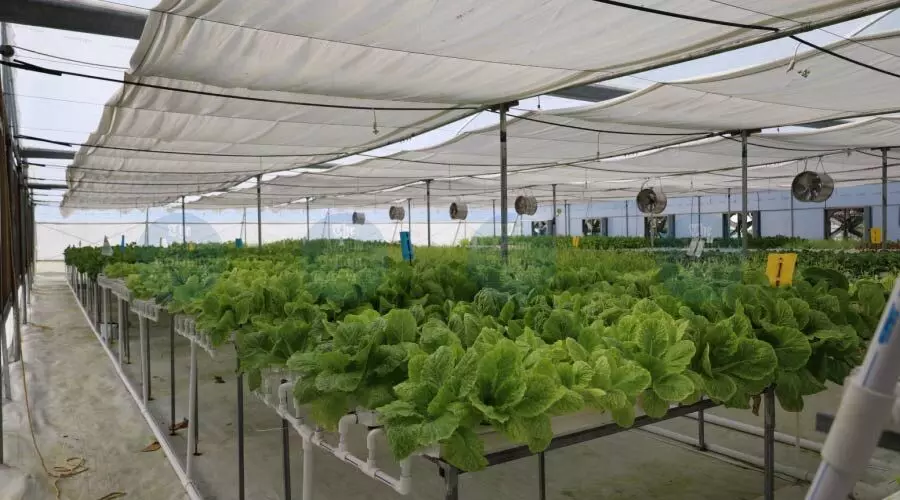
An image of the hydroponic farm in Rawanboi, Sualkuchi. (AT Photo)
Amingaon, Nov 20: Aiming to revolutionise agriculture in Northeast through sustainable and innovative farming practices, a group of educated youth have initiated high technology-driven farming of exotic crops and herbs here at Rawanboi in Sualkuchi in a climate-controlled polyhouse (CCPH).
The group consists of four members Hemanga Baishya, founder CEO; Bikram Basumatary, chief technical officer; Pabitra Kumar Baishya, managing director; and Pragyan Jyoti Goswami chief marketing officer of Studio Greens, a unit of Maa Kameshawari Agro Products LLP.
The group members grow clean, fresh and responsibly cultivated produce using smart farming techniques in a poly house that is spread in 1,056 square metre, which can house 24,000 plants. In this technique instead of soil, a solution of water, and micro and macro nutrients is used for plants to grow in artificially-controlled temperature.
Water requirement in hydroponics is 90 per cent less than conventional farming which ensures the health of crops and supports a cleaner and greener future. The crop besides being greener than the crops in traditional farming, can be carried out throughout the whole year.
Most importantly, harvesting period of most of the planted vegetables is minimum 40-45 days and maximum 90-120 days. Referring to the lettuce of Romaine and Iceberg varieties, which are single harvest crop, the group members said an experiment is being carried out to make it multi-harvesting crop.
The produces, which have huge demand in the market, are supplied to hotels and restaurants in Guwahati. The slew of exotic horticultural vegetables farmed in the poly house include basil (Italian and Thai variety,) bokchoi, microgreen, cherry tomatoes, lettuce of iceberg, butterhead, lollo red, and Romaine varieties, rocket, Chinese cabbage, kale, celery, parsley, etc.
Each crop is cultivated using phased planting cycles to ensure uninterrupted supply which is supported by precision-controlled environments for temperature, humidity and nutrient levels. Considering the eco-conscious practice, including minimized transportation needs, it is instrumental in mitigating climate crisis.
While, the vegetables are grown on bed, the cherry tomatoes are grown in bag. Nutrition, PH and temperature are automatically controlled by the auto doser that is installed outside the poly house.
“The farming being very sensitive, nutrition, temperature, including PH level must be moderate,” the cultivators said.
Talking to this correspondent, Hemanga Baishya, founder chief executive officer said, “The goal of our farming is not hotel-oriented. Instead, we want our produce reach and every household. We are getting good response from the market in some of the varieties like lettuce and basil. The demand from the market is very high. We are yet to meet such demands.”
Underscoring the need of switching over to soilless farming, he said, “Soilless farming is the future for humanity as soil quality will deteriorate in future. Long-term agricultural viability by minimizing environmental impact is the need of the hour,” adding that eco-friendly tilling practices will be a boon for the future generations.
“We have a plan to help farmers grow fresh, pesticide-free vegetables on their own without harming environment with limited resource like water,” Baishya, an MBA from Gauhati University, said.
While asked on opting for this sensitive venture, Bikram Basumatary, chief technical officer, who is also an MBA from Gauhati University, said, “Seeking jobs for personal gain is not our objective. What matters more for us is to become job provider without being detrimental to environment by boosting eco-friendly agriculture practice.”
Referring to the Vision 2025 document of Government of Assam which highlights a potential deficit of 6,51,815 MT in vegetable sector by 2025-26 if production grows at this rate, Basumatary remarks,
“By producing locally, we insist on reducing the dependency on imported vegetables and through technology, organic farming and community engagement we want to build a future where agriculture thrives doing good both to people and our planet.”
However, talking about the initial hurdles they faced, the members of the group stated that no bank was willing to give them loan for initiate the project.
“After running from pillar to post, we succeeded in getting financial assistance from Punjab and Sind Bank, Maligaon branch which sanctioned us a loan,” they informed.
Notably, the hydroponic structure was created under Agricultural Infrastructure Fund (AIF), 2024-25 with 3 per cent interest subvention under AIF scheme of Govt of India. The loan amount was Rs 1.35 crore was provided by the Punjab and Sind Bank, Maligaon branch.
Moreover, the group got a sanction of Rs 15.0 lakh for the installation of one 5 MT Solar Cold storage unit (staging) at 50 per cent subsidy under HMNEH, 2024-25 from Directorate of Horticulture and Food Prpcessing, Assam.
Nripen Chandra Das, director, Horticulture and Food Processing, said “Growing of leafy vegetables under hydroponic system is very easy. If we plan as per local and market demand, farmers can earn more profit from the system.
Though initial installation cost is high, proper planning of cropping sequence may lead to more sustainable and beneficial one.”
District Agricultural Officer, Kamrup, Manabjyoti Das said, “They are the pioneer in Kamrup district in such cultivation.
We are actively monitoring the project which will be one of the best projects of Kamrup. Unemployed youth should come forward to start such initiative instead of running after jobs by availing the benefits provided by the department to boost agriculture.”