
Flood-free Assam remains elusive, data cites deep crisis despite poll promises
Heavy siltation in districts like Dhemaji & Lakhimpur, has caused irreversible damage to cropfields forcing farmers to look for other income & livelihood alternatives
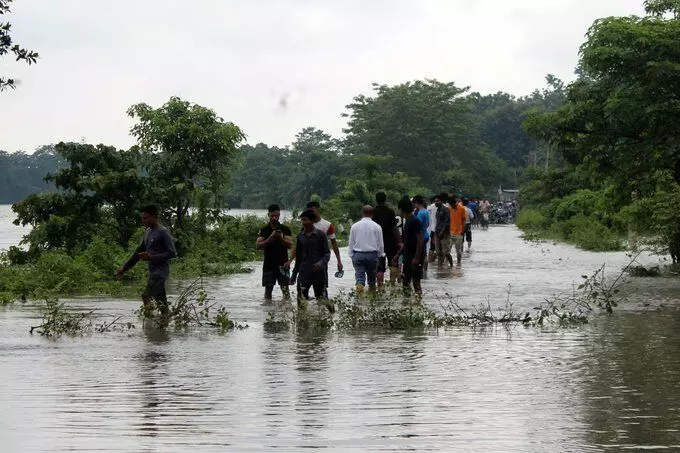
A file image of floods in Assam (Photo: IANS)
Guwahati, April 8: Promises of a flood-free Assam have become a recurring slogan in every election, but on the ground, the crisis is only deepening.
Studies indicate that not only has the flood impact worsened, but associated hazards have also grown into a serious concern.
Satellite imagery data reveals that the cumulative flood inundation area in the State increased during the period 1998-2023, with the highest being observed in 2020 (12.86 lakh hectares), followed by 2022 (12.15 lakh hectares).
This is despite the fact that monsoon rainfall in the State has been on the decline in the last five years – recording consecutive below-normal precipitation since 2020.
“The extent of flood inundation varied significantly, ranging from 2.11 lakh hectares in 2009 to 12.85 lakh hectares in 2020, indicating the severity of the floods and their impact on the region over the years,” a National Remote Sensing Centre analysis stated.
Flood inundation areas between 10-12.85 lakh hectares were observed during four years – 2002, 2017, 2020, and 2022. Areas between 8-10 lakh hectares were inundated in six years – 1998, 1999, 2003, 2004, 2007, and 2019. Further, flood inundation between 5-8 lakh hectares occurred in eight years – 2000, 2008, 2012, 2015, 2016, 2018, 2021, and 2023.
Lastly, flood-affected areas ranging from 2-5 lakh hectares were recorded in eight years – 2001, 2005, 2006, 2009, 2010, 2011, 2013, and 2014, it revealed.
The number of flood-affected districts has also seen a rising trend during the period, peaking in 2018, and crossing the 30 mark in all years from 2017 to 2023.
According to the government flood memorandums, the highest population affected by flood since 2010 was in the year 2019 (over 70 lakh), followed by 2020 (58 lakh) and 2022 (57 lakh). Since 2021, the highest number of human lives lost in flood was reported in 2022 (179).
Researchers say while the impact of floods has also increased, the associated hazards like sedimentation in the catchment areas have become a major concern.
Heavy siltation in districts like Dhemaji and Lakhimpur, has caused irreversible damage to cropfields forcing farmers to look for other income and livelihood alternatives, according to a study by Dr Akangsha Borgohain of Gauhati University.
There are 87 wetlands in the State which are more than 100 hectares in area.
Around 80 per cent of 37 of them have been lost, largely reducing their water retention capacity, and leading to inundation of newer areas, Prof Dhrubajyoti Sahariah of Gauhati University said.
“Piece meal approach of tackling flood will yield no results. If you find a solution in one place, it will trigger a problem in another. A holistic multidimensional river basin management plan is required, jointly with neighbouring states. The Brahmaputra is a young dynamic river. Flood adaptation measures are more important than flood control in this valley,” Sahariah added.