
BTC winter session begins under ST protests' shadow; 22 UPPL leaders quit in Bijni
To ensure inclusive representation, six individuals from diverse communities were nominated as Members of the Council Legislative Assembly
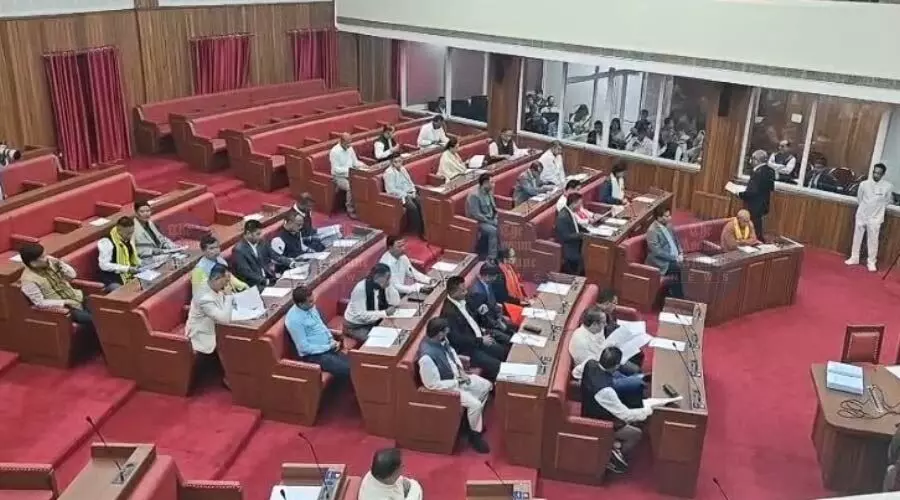
Kokrajhar/Bijni, Dec 1: The two-day Winter Session of the Bodoland Territorial Council (BTC) began on Monday, with the House deliberating on a range of issues critical to governance and development in the Bodoland Territorial Region (BTR).
A major concern that dominated the floor was the acute shortage of personnel across key departments.
The BTC currently has 300 vacant gazetted, Grade I and II posts, while the health sector alone faces a shortfall of 150 doctors.
Representatives noted that the BTR being a malaria-prone zone further amplifies the urgency of filling medical vacancies.
“There are also some unresolved issues with Bodoland University, the medical college and BSc Nursing colleges, especially regarding infrastructure. Tamulpur district still lacks basic administrative buildings; from district to sub-divisional offices. Many matters need proper, focused discussion,” said BPF chief whip and BTC Executive Member, Derhasat Basumatary.
UPPL MLA Daobaisa Boro said the opposition sought clarity on whether the new BTC administration would implement all clauses of the Bodo Peace Accord.
“We raised important issues for the people. We wanted to know if the new council will implement all Accord clauses. BTC chief Hagrama Mohilary assured us the government will analyse them before taking steps,” he said.
Meanwhile, to ensure inclusive representation, six individuals from diverse communities were nominated as Members of the Council Legislative Assembly (MCLA).
They are, namely Karmeshwar Roy (Rajbongshi), Ratan Chandra Rabha (Rabha), Nand Lal Magar (Gorkha), Hemprabha Devi (Koch), Ajay Kumar Hazarika (Kalita) and Ridip Kumar Deka (Sarania Kachari).
Away from the Council hall, political tensions deepened in Bijni as 22 Koch-Rajbongshi leaders and workers resigned en masse from the UPPL, expressing resentment over the party’s “indifferent attitude” towards the community’s demand for Scheduled Tribe (ST) status.
“Workers and officials from the entire Bijni district resigned together today. We thank the Assam government for including Koch-Rajbongshi in the ST report. But since the UPPL opposed the government’s decision, we chose to quit. This resignation drive will continue,” said Shankar Barman, vice-president of the Bijni District Youth Cell.
The resignations came on the heels of massive protests by tribal students on November 29, opposing the state government’s move to grant ST status to six additional communities.
The agitation escalated dramatically when protesters stormed the BTC Secretariat, tearing down the main gate and vandalising parts of the Assembly House.
In response, the Kokrajhar district administration had imposed Section 163 of the Bharatiya Nagarik Suraksha Sanhita (BNSS) on Sunday, restricting public movement and gatherings across the Secretariat Complex and nearby areas.
Chief Secretary Ravi Kota and senior officials of multiple Assam government departments were present as discussions began on strengthening administrative efficiency and addressing long-standing gaps in essential services.