
Assamese diaspora in London hosts 577th Sankar Jayanti
Critic Mayur Bora said Srimanta Sankaradeva democratized religion & fostered social equality in Assam
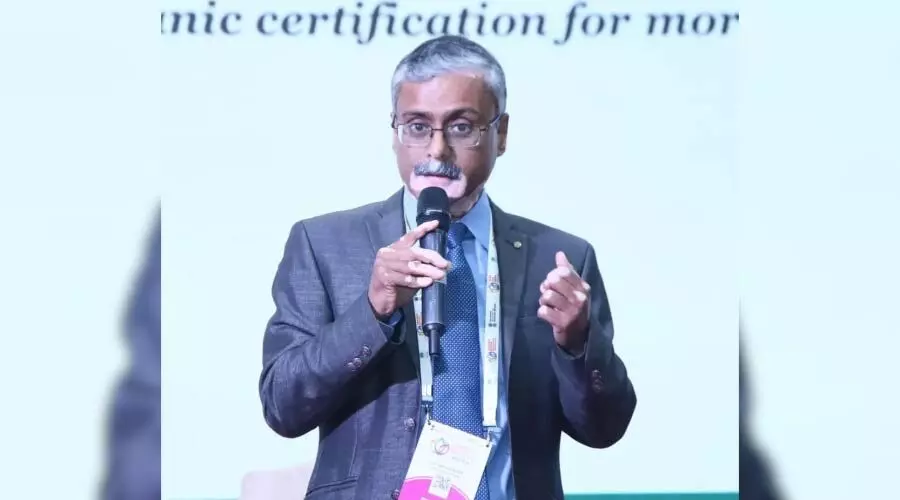
A file image of Assamese critic Mayur Bora (Photo: Mayur Bora/meta)
Guwahati, Oct 21: Srimanta Sankaradeva successfully challenged the mediaeval religious order, democratizing religion and making it inclusive. This was at a time when a powerful coterie of the priestly class had made religion their fiefdom to further their vested agenda.
Observing this at the 577th Sankar Jayanti celebrations organized by Asam Sahitya Sabha, UK (ASSUK) at Kings Langley Community Centre, London on October 18, eminent critic and thinker Mayur Bora said that Sankaradeva judiciously avoided, unlike some of his contemporaries or predecessors of the pan-India Vaishnavite movement, a direct conflict with the priestly class.
“He chose a more subtle and adroit manner to effect the desired social changes instead of engaging himself in a direct confrontation with the Vedic clergy. He was successful in his own subtle and inimitable way to make the cumbersome and unduly-elaborated religious rituals look irrelevant through his steadfast yet non-combative promotion of the Bhakti movement. This saw a large number of people discard the divides of caste and creed and get into his fold,” he said.
“Sankaradeva was more a social and cultural reformer than a religious leader. The renaissance man of Assam who enriched multiple spheres of human activity, including art and literature, Sankaradeva gave the Assamese people an enduring socio-cultural legacy that found resonance with the masses cutting across creed and community,” Bora observed.
Terming Sankaradeva’s thrust on egalitarianism as a most defining aspect of his liberal philosophy, Bora said that the exceptionality of his mission was corroborated by his encompassing of wide-ranging social spheres.
“This he enriched with his unparalleled creative genius. This was fundamental to ushering in a cultural renaissance with an egalitarian ethos at its core in medieval Assam. Religion was a very important and dominant social factor in those days, and Sankaradeva reformed both religion and social life,” Bora noted, adding that he reshaped religion and culture by drawing people away from the derogatory practices prevalent in those times.
Other striking tenets of Sankaradeva’s preaching, Bora said, concerned woman empowerment and respect for nature and environment.
Emphasizing on the non-religious side of Sankaradeva, Bora said that he practised what he preached and it particularly showed on his attitude towards woman. “He never barred his wife Kalindi Aai from offering obeisance to Ghar Jeuti, a deity, even though his own preaching was for total devotion to one supreme God only. Similarly, Chandari Aai, a domestic help, used to exhibit remarkable erudition while interacting with scholars – something she acquired due to an enabling home ambience,” Bora said.
The other highlights of the day included a cultural programme, naam prasanga, Sattriya dance, Borgeet recital and tabla recital by several Assamese living in and around London.
Earlier, Nirala Barua explained briefly about Sankaradeva, and Jahnabi Gogoi spoke elaborately on the great saint-reformer for the benefit of the second and third generations Assamese children and youths living in the UK. Manjira Chowdhury led the naam prasanga.
Geeta Borooah, president of ASSUK, also spoke on the occasion. The programme was attended by people from different parts of England, Scotland and Wales.
By Staff Reporter