
Assam to send 50 wild Buffaloes, pair of rhinos to MP under wildlife pact
In return, Madhya Pradesh will provide Assam with a pair of tigers and six mugger crocodiles to help diversify and strengthen Assam’s wildlife populations.
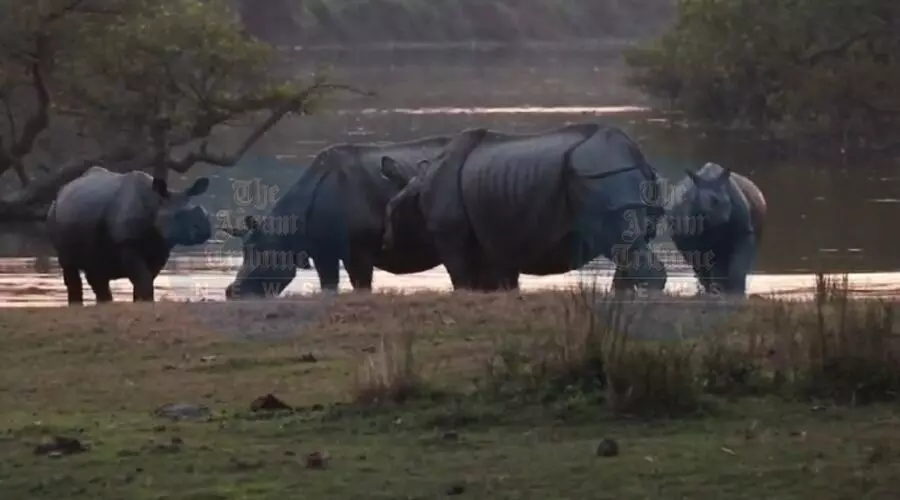
AT Photo: One-horned rhinoceros in Assam's Kaziranga National Park
Bhopal, Jan 9: With an aim to boost inter-state wildlife conservation, Madhya Pradesh Chief Minister Dr Mohan Yadav on Thursday met Assam Chief Minister Himanta Biswa Sarma in Guwahati, where the two leaders reached a principled agreement on the exchange of wild animals between the two states.
The initiative aims to strengthen biodiversity and revive species that have become locally extinct in certain regions.
As part of the agreement, Assam will translocate 50 wild water buffaloes to Madhya Pradesh over the next three years in a phased manner.
In addition, a pair of one-horned rhinoceroses and three king cobras will also be sent to the state.
While the rhinos and king cobras will initially be housed at Van Vihar National Park in Bhopal for acclimatisation and public display, the wild buffaloes will be reintroduced into their historical habitat at Kanha Tiger Reserve.
In return, Madhya Pradesh will provide Assam with a pair of tigers and six mugger crocodiles to help diversify and strengthen Assam’s wildlife populations.
Announcing the development on social media platform X, Chief Minister Yadav said the initiative would play a crucial role in enriching wildlife and biodiversity in Madhya Pradesh. He added that the reintroduction of the wild buffalo — extinct in the state for over a century — marks a major conservation milestone.
Dr Yadav noted that the programme builds on the state’s recent conservation successes, including the reintroduction of cheetahs at Kuno National Park, and reflects Madhya Pradesh’s commitment to restoring species that once thrived in its forests. The state is already recognised nationally as the ‘Tiger State’ and ‘Leopard State’.
The wild water buffalo (Bubalus arnee), listed as endangered, has a global population of fewer than 4,000, with the majority found in Assam’s Kaziranga and Manas National Parks.
A detailed study conducted by the Wildlife Institute of India (WII), Dehradun, identified Kanha Tiger Reserve as a suitable site for reintroduction, citing its extensive grasslands, reliable water sources, minimal human disturbance and favourable ecological conditions.
With inputs from IANS