
Assam Polls: Opposition alliance reshapes close-contest seats
In 2021, 6 upper Assam constituencies – Sonari, Jorhat, Naharkatiya, Sadiya, Amguri, & Duliajan – the combined vote share of Congress and AJP exceeded that of the winning NDA candidates.
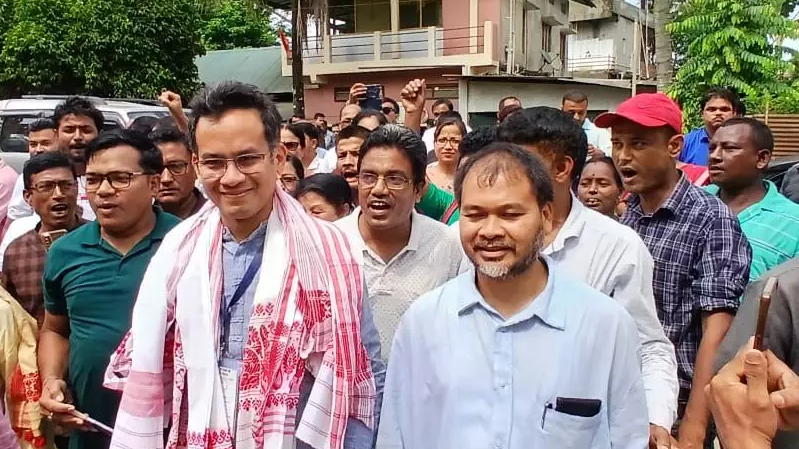
A file image of APCC Chief Gaurav Gogoi and Raijor Dal President Akhil Gogoi (Photo: @AkhilGogoiAG/X)
GUWAHATI, April 6: The 2021 Assembly elections were marked by a number of closely contested seats. Two constituencies were decided by margins of fewer than 1,000 votes, while 13 seats saw victory margins under 5,000 votes. An additional 12 constituencies were won by less than 10,000 votes.
These narrowly decided seats have now emerged as key battlegrounds, with political parties focusing considerable attention and resources on securing them.
A major shift in the electoral equation this time is the alliance between Congress, AJP, and Raijor Dal, which has introduced a new dynamic to vote consolidation. In 2021, the absence of such coordination allowed vote fragmentation to influence outcomes in several constituencies.
In 2021, in at least six upper Assam constituencies – Sonari, Jorhat, Naharkatiya, Sadiya, Amguri, and Duliajan – the combined vote share of Congress and AJP exceeded that of the winning NDA candidates.
Even in Dhemaji, where BJP had a larger margin, the gap between the party and a hypothetical Congress-AJP combine stood at around 13,000 votes, suggesting that consolidation could still make contests more competitive.
In Barhampur, BJP’s Jitu Goswami had defeated the Congress candidate by a slender margin of 751 votes.
Similarly, in Nazira, Congress leader Debabrata Saikia won by just 683 votes. Notably, AJP, contesting independently at the time, secured around 7,800 votes in Nazira and 2,000 in Barhampur – figures that could prove decisive under the current alliance framework.
The rematch in Nazira between Debabrata Saikia and Moyur Borgohain is expected to be closely watched, while in Barhampur, Jitu Goswami now faces a Congress-backed AJP candidate Rajen Gohain.
A narrow margin was also recorded in Dudhnoi, where Congress candidate Jadav Swargiary had won by 1,276 votes. Although both major parties are again competing for the seat, they have introduced new candidates, indicating strategic recalibration.
Comparable margins were observed in Bijni (1,003 votes) and Udharbond (2,685 votes), reinforcing the importance of micro-level electoral strategies.
Teok presents another interesting contest, with a renewed face-off between AGP and Congress. In 2021, AGP had edged past Congress by just 1,350 votes. This time, Congress has fielded Pallabi Gogoi again, while AGP has nominated Bikash Saikia.
In Lakhimpur, BJP’s Manab Deka had secured victory by a margin of 3,096 votes, while in Thowra, Sushanta Borgohain (then with Congress) had won by 2,006 votes. Similarly, Rupjyoti Kurmi’s victory in Mariani (2,446 votes) and Hiten Goswami’s win in Jorhat (under 7,000 votes) points at prevalence of tight races.
From a macro perspective, in the 2021 elections, winning candidates secured 44.47 per cent of the total votes. The NDA’s overall vote share stood at 44.51 per cent, only marginally ahead of the Congress-led Mahajot (which included AIUDF) at 43.68 per cent.
Smaller parties, including AJP and Raijor Dal, accounted for 4.74 per cent of the vote – enough to influence outcomes in tightly contested seats.
Congress had contested 95 seats, AJP 82, and Raijor Dal 29 in 2021. The lack of coordination among these parties likely contributed to vote splitting in several constituencies.
Noting the significance, both NDA and Congress-led alliance have put special efforts on these seats. While Prime Minister Narendra Modi himself campaigned at Lakhimpur, Congress’s Priyanka Gandhi Vadra spoke at a rally at Nazira.