
Assam Assembly passes Prohibition of Polygamy Bill 2025 after fiery debate
Opposition called the bill unconstitutional, while Chief Minister Himanta Biswa Sarma defended it as a pro-women reform
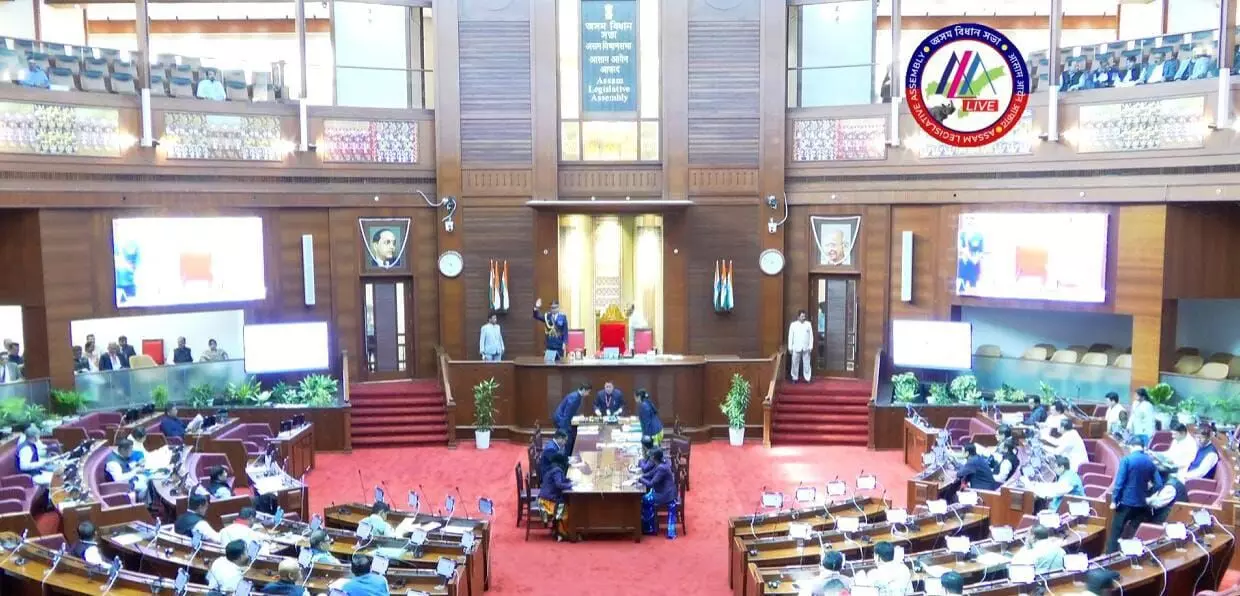
A file image of Assam legislative assembly (Photo: Assam Legislative assembly/Youtube)
Guwahati, Nov 27: After hours of intense deliberations marked by sharp political exchanges, legal objections and emotional appeals, the Assam Legislative Assembly on Thursday passed the Assam Prohibition of Polygamy Bill 2025, clearing the way for the state to move towards banning the practice through law.
The passage of the bill came amid strong resistance from opposition members who termed it unconstitutional and selective, even as the ruling government defended it as a landmark reform aimed at empowering women and ensuring gender justice across all communities.
The debate revealed deep divisions within the House, with members clashing over constitutional provisions, religious freedoms and the alleged targeting of specific communities, before the treasury benches secured the necessary support to see the legislation through.
Raising serious constitutional concerns, Abdul Rashid Mandal said marriage falls under the Concurrent List and both the Centre and the state can legislate on it, but warned that any state law overriding central Muslim personal law would trigger legal contradictions.
“As per Articles 14, 15 and 21, this bill violates constitutional provisions. We oppose the fact that it applies only to selected communities and regions. Law must be equal for all,” he said, adding that parents and society should not be punished for marriages carried out without their knowledge.
He also opposed Section 11 of the bill, stating, “Without definite charge or warrant, police should not raid or search a house. This is ultra vires, unconstitutional and beyond the capacity of state legislation.”
On the other hand, ruling party MLA Suman Haripriya strongly backed the bill, calling it a long-overdue step toward empowering women.
“Just imagine how a woman feels when her husband marries again despite having a wife at home. The man never thinks about her, but this bill does,” she said, claiming that in some minority-dominated areas, girls from other communities are exploited under the pretext of polygamy.
She also demanded a toll-free helpline for affected women.
Aminul Islam Jr challenged the necessity of the bill, arguing that Islamic law already prescribes strict conditions for a second marriage.
“We are not encouraging men to marry multiple women. It is allowed only in unavoidable circumstances and under strict conditions, including equal treatment and consent,” he said, adding that the bill “directly affects Articles 25, 26, 14, 15 and 21” and accused the government of targeting Muslims.
“These laws are a step to lay hands on our Quran,” he alleged.
Citing statistics, Asraful Hussain noted that polygamy is not exclusive to Muslims.
“In Assam, the polygamy rate among non-Muslims is 1.8 while among Muslims it is 3.6. But states like Meghalaya, Arunachal, Mizoram and Odisha have even higher rates,” he said.
Similar concerns were echoed by Jakir Hussain Sikdar and Rafiqul Islam, who questioned why the bill is limited to specific regions and pointed out that polygamy exists across communities.
“Yes, Quran allows multiple marriages but under strict conditions. It does not encourage it,” Rafiqul said.
Raijor Dal MLA Akhil Gogoi accused the government of politicising the issue.
“If a person has conscience, he won’t think of marrying again. From that perspective the bill looks valid, but exempting Sixth Schedule areas shows selective application,” he said, alleging communal intent.
“The BNSS already prohibits polygamy. Why bring another law? Punishing the couple may be fine, but punishing parents and society is not valid.”
Responding to the barrage of criticism, Chief Minister Himanta Biswa Sarma firmly defended the bill, describing it as a continuation of his government’s women-centric policies.
“Women empowerment is one of our motives and we don’t think about religion. We want a government biased towards females,” he said, linking the move to initiatives like Orunodoi and the Nijut Moina scheme.
He dismissed allegations of communal targeting, stating, “This bill does not mention any particular community. It is applicable to all.”
On the exemption of Sixth Schedule areas, Sarma clarified that autonomous councils like BTC have legislative powers under the Bodo Accord and their consent is mandatory.
“After this bill passes, we hope Sixth Schedule areas will also bring their own laws,” he added.
Highlighting the rationale behind the legislation, Sarma said, “In Islamic law, monogamy is the rule and polygamy the exception. Which man can truly love and treat two wives equally? There will always be bias.”
He also referenced the Supreme Court’s push towards a Uniform Civil Code, asserting, “If the opposition cannot stop me, I will definitely bring the Uniform Civil Code in Assam.”
He further warned that anyone facilitating illegal polygamous marriages, including qazis and family members, would also face punishment.
“If parents or qazis become partners in the crime, they will be punished,” he declared.