
Activist moves UNESCO against Kaziranga elevated corridor, cites threat to wildlife
In a letter addressed to UNESCO Director-General, Prasanta Kumar Saikia, said the construction is in total violation of the World Heritage Convention
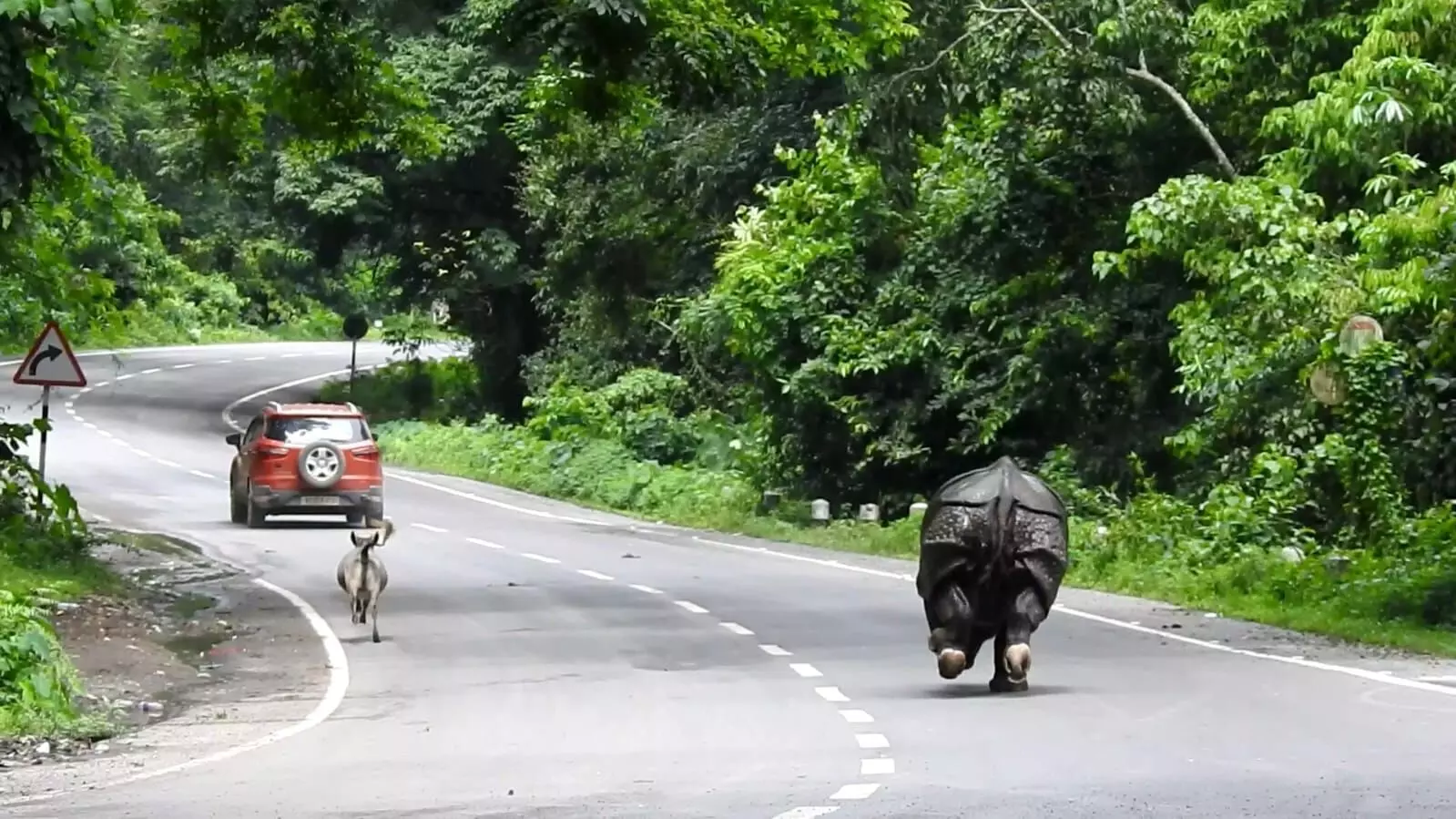
A file image of one-horned rhino in NH-715 of Kaziranga National Park
Guwahati, Nov 24: The proposed 35-km elevated corridor skirting the southern edge of Kaziranga National Park has come under scrutiny after a wildlife activist wrote to the Director-General of UNESCO, alleging that the project violates the World Heritage Convention and poses severe risks to endangered species in the park.
In a letter addressed to UNESCO Director-General Khaled El-Enany, Prasanta Kumar Saikia, a resident of Gomothagaon (Kuwaritol) in Nagaon, said the construction of the corridor would irreversibly damage Kaziranga’s “integrity and outstanding universal value (OUV).”
He urged UNESCO to intervene immediately.
“As a nature-loving resident of India, I strongly oppose the proposed project… the construction of the 35 km-long elevated corridor along the southern periphery of the Kaziranga National Park is in total violation of the World Heritage Convention,” Saikia wrote.
He argued that the prolonged construction phase, marked by loud machinery, heavy vehicular movement, vibrations and increased human activity, would severely disrupt animal movement through traditional corridors and disturb breeding patterns of several endangered species that depend on these habitats.
Saikia also raised concerns over the government’s plan to alter the alignment of National Highway 715 (formerly NH-37), beginning south of the Koliabor tri-junction and running east to west along the southern periphery of the Burhapahar Range.
“This area forms an ecologically sensitive buffer to the Kaziranga National Park and Tiger Reserve. The planned road development poses a severe threat to wildlife movement corridors that connect the hills of Karbi Anglong with the floodplains of Kaziranga,” the letter noted.
He urged UNESCO to dispatch an urgent fact-finding or monitoring mission to evaluate the ecological implications of both the elevated corridor and the revised highway alignment.
Saikia also requested that the Centre and the Assam Government suspend all construction activities in the affected zones until a comprehensive environmental assessment is completed.
Authorities defend project
The elevated corridor has long been pitched as a transformative project aimed at enabling safer, uninterrupted movement of animals across Kaziranga, particularly during monsoon flooding when wildlife frequently crosses the highway and vehicle hits spike.
On November 6, Kaziranga National Park Director Sonali Ghosh told The Assam Tribune that elevated wildlife corridors have been successfully implemented in several protected areas across India. She said multiple options were studied to safeguard animal mobility, and the elevated corridor was deemed the most effective.
The Wildlife Institute of India had cleared the proposal nearly 20 years ago, but the project saw delays. With new technology now available, the corridor will be executed by the National Highways Authority of India (NHAI).
Chief Minister Himanta Biswa Sarma, had earlier said that the foundation stone-laying ceremony of the corridor is expected to be completed by year-end.
Recently, during a meeting of the Cabinet Committee on Economic Affairs (CCEA) chaired by Prime Minister Narendra Modi, the Centre had approved the widening of the Kaliabor–Numaligarh section of NH-715 to four lanes, incorporating wildlife-friendly measures along the Kaziranga stretch.