
Dibrugarh's endearing influence on journalism in Assam
Before Guwahati became Assam’s media hub, Dibrugarh pioneered English and Assamese journalism through iconic publications
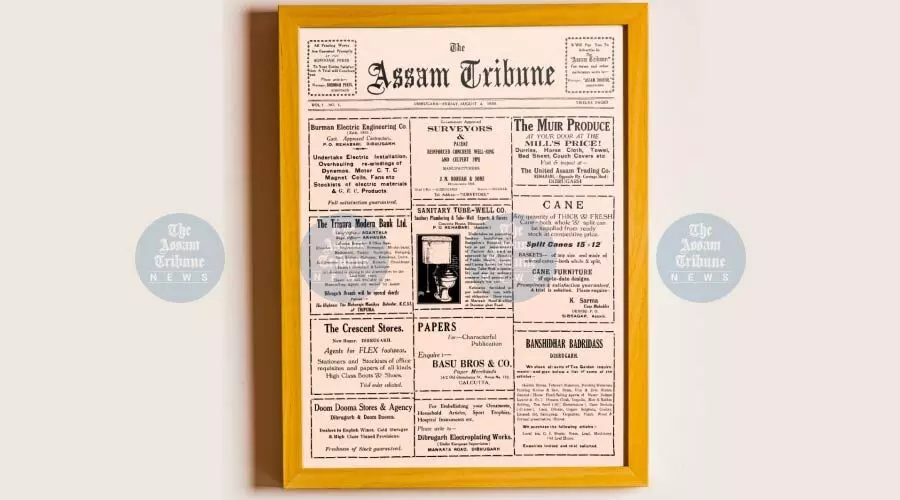
The front page of the first issue of The Assam Tribune as a weekly on August 4, 1939
Dibrugarh, Aug 12: Long before Guwahati emerged as the media epicentre of Northeast India, the town of Dibrugarh quietly laid the foundation for modern journalism in Assam.
In the late 19th century, the "Tea City', which is now often referred to as Assam's second capital, ignited the first sparks of journalistic expression in the region, both in English and Assamese.
Following the pioneering legacy of Orunodoi (1846-1883), the first Assamese monthly published from Sivasagar, Dibrugarh quickly established itself as a key centre of journalistic activity. Through influential publications such as The Times of Assam, The Assam Tribune, and Asomiya, the city played a seminal role in nurturing political consciousness, fostering cultural development, and advancing public discourse across Assam.
To this day, Dibrugarh's press legacy remains vibrant. Prominent newspapers such as The Assam Tribune, The Sentinel, and leading Assamese dailies like Dainik Asam, Asomiya Pratidin, and Asom Aditya, along with tabloid publications such as Pratishan (temporarily suspended) and Spandan, continue to be published from the city-a testament to its enduring status as a historic media pioneer.
Among the earliest milestones in Dibrugarh's journalistic history was the founding of The Times of Assam on January 5, 1895. Established by Radhanath Changkakoti and supported by notable figures such as Dr John Berry White the visionary behind the Berry White Medical School (now the Assam Medical College and Hospital) the newspaper served a diverse readership, including English-educated Assamese elites, colonial administrators, and tea planters. Until its closure in September 1947, The Times of Assam offered a vital platform for reformist thought, intellectual debate, and political engagement during the tumultuous colonial era.
In 1902, The Eastern Herald, the second English weekly newspaper from Dibrugarh, was launched under the editorship of lawyer Bashambad Mitra, who was also associated with The Times of Assam. However, the publication ceased operations after approximately a year and a half. The third newspaper to emerge from Dibrugarh was The Citizen, edited by Kalinath Rai. Despite its regular publication and local relevance, The Citizen was dis-continued after five years.
Equally important was the development of Assamese language journalism in the region. Several Assamese publications such as Dipti, Assam Bandhab, Jugor Pothot, and Ronor Batori made their appearance, but all were eventually discontinued.
One of the most notable early Assamese newspapers from Dibrugarh was Asomiya, launched as a weekly on March 14, 1919, by Chandra Kumar Agarwalla. Although it was later relocated to Guwahati in 1924, Asomiya began its journey in Dibrugarh, offering vernacular readers news, editorial commentary, and cultural insights at a time when indigenous voices were striving to make themselves heard.
A defining moment in Assam's media history came with the launch of The Assam Tribune on August 4, 1939. Initiated as a weekly from Dibrugarh by Radha Govinda Baru-ah, with Lakshminath Phookan as its founding editor, the publication swiftly earned a reputation as a credible voice on both regional and national affairs. By 1946, it had shifted to Guwahati and became a daily newspaper, eventually establishing itself as the most widely read English daily in Northeast India. Yet, its roots in Dibrugarh remain an enduring symbol of the town's early media leadership.
Over the decades, Dibrugarh also served as the birth place of several other vernacular publications some no longer in circulation from the city-such as New East News-line, Janasadharan, Niyomiya Barta, Bhumiputra, Pratibimba, Dainik Janagan, Asom Spandan, and the Bengali daily Jugashangkha. While these publications have since shifted or become defunct, they reflect the city's once-thriving role as a journalistic incubator.
Dibrugarh's prominence in early journalism illustrates a larger historical truth: long before the advent of electronic media, the printed press served as a powerful tool for nationalist expression, social reform, and the assertion of linguistic and cultural identity. Whether through English-language dailies like The Times of Assam and The Assam Tribune, or vernacular efforts like Asomiya, Dibrugarh nurtured Assam's earliest journalistic consciousness.
The contributions of press pioneers such as Radhanath Changkakoti, Radha Govinda Baruah, Chandra Kumar Agarwalla, and several others laid the intellectual and institutional foundation upon which the modern Assamese media landscape has been built. Their legacy remains timeless - proof that a provincial town, driven by vision and courage, could become the wellspring of a region's journalistic identity.
- Pores Aind